Beyond GDPR: Building Digital Sovereignty
Through Cloud Architecture
A Strategic Guide for European Enterprises in 2026
Complete Visual Archive — 26 Infographics & Diagrams
The Digital Sovereignty Imperative
Foundational concepts, regulatory timeline, and architectural principles
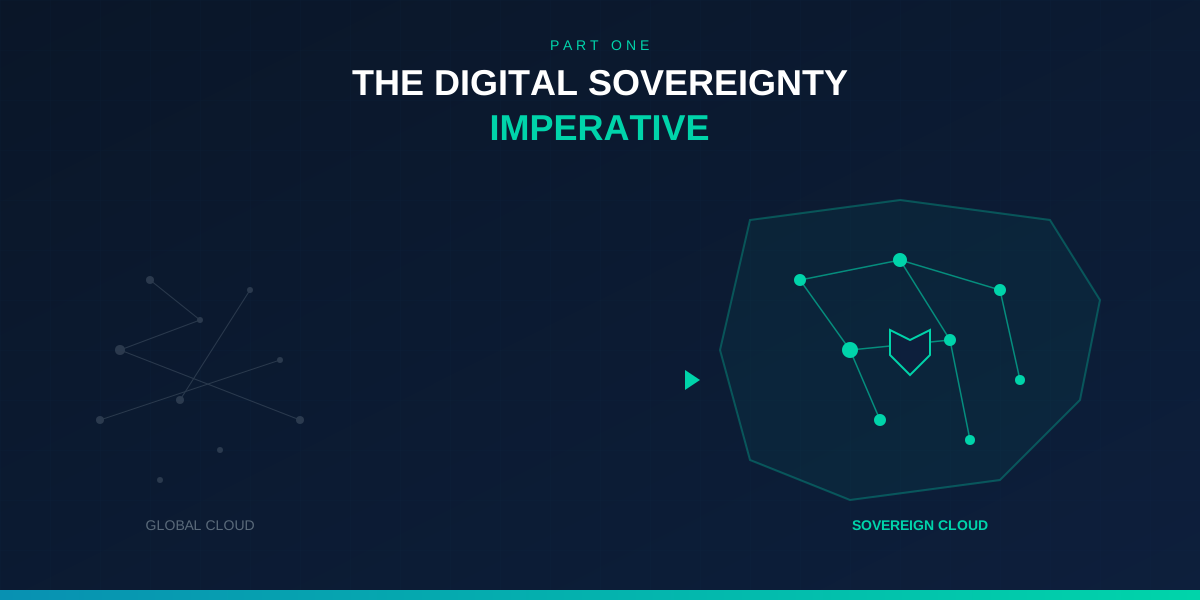
This diagram presents a visual transformation from traditional global cloud infrastructure to sovereign cloud architecture. On the left side, scattered gray nodes with chaotic, unorganized connections represent the dispersed and unpredictable nature of global cloud services. A directional arrow in teal flows from left to right, symbolizing the transition toward sovereignty. On the right side, organized teal nodes are contained within a defined boundary representing the EU jurisdiction, with a central shield icon symbolizing protection.
Key Points:
- Global cloud operates without jurisdictional boundaries, leading to data location uncertainty
- Sovereign cloud provides geographic containment within EU/national borders
- The transition represents a shift from provider-controlled to customer-controlled infrastructure
- The shield symbol emphasizes security through jurisdictional protection
Additional Context: The concept of digital sovereignty emerged as a direct response to the 2013 Snowden revelations and the subsequent realization of foreign surveillance risks under laws like the US CLOUD Act. The sovereign cloud model addresses this by ensuring that data, infrastructure, and operational control remain within a specific legal jurisdiction, typically aligned with EU law (GDPR, NIS2) or national regulations.
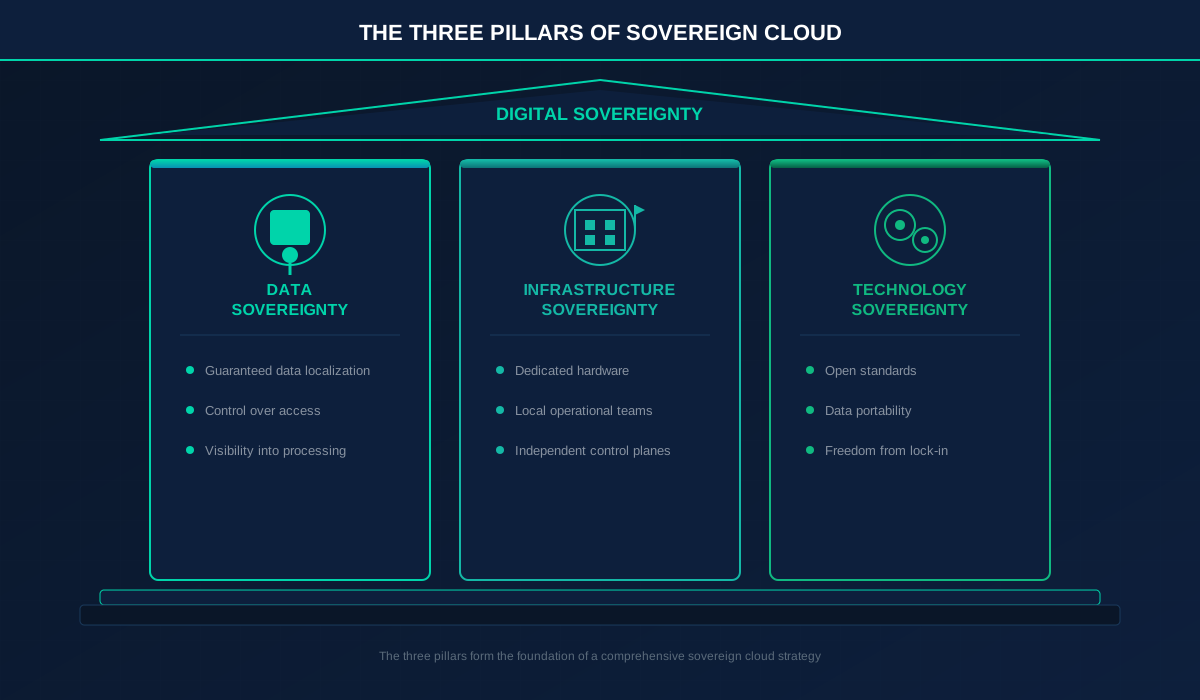
This diagram depicts a classical architectural temple structure with three distinct pillars supporting a pediment labeled "Digital Sovereignty." Each pillar represents a foundational element: Data Sovereignty (left, in teal), Infrastructure Sovereignty (middle, in cyan), and Technology Sovereignty (right, in green). Each pillar contains an icon and specific characteristics listed as bullet points.
Key Points:
- Data Sovereignty ensures guaranteed data localization, control over access, and visibility into processing
- Infrastructure Sovereignty provides dedicated hardware, local operational teams, and independent control planes
- Technology Sovereignty enables open standards, data portability, and freedom from vendor lock-in
- The three pillars work interdependently to create comprehensive sovereign cloud strategy
Additional Context: The three-pillar model reflects a holistic approach to sovereignty that goes beyond simple data residency. Data Sovereignty addresses the "where" question, Infrastructure Sovereignty tackles the "who" question, and Technology Sovereignty addresses the "how" question. Together, these pillars form the basis of what the European Commission calls "strategic autonomy" in digital infrastructure.
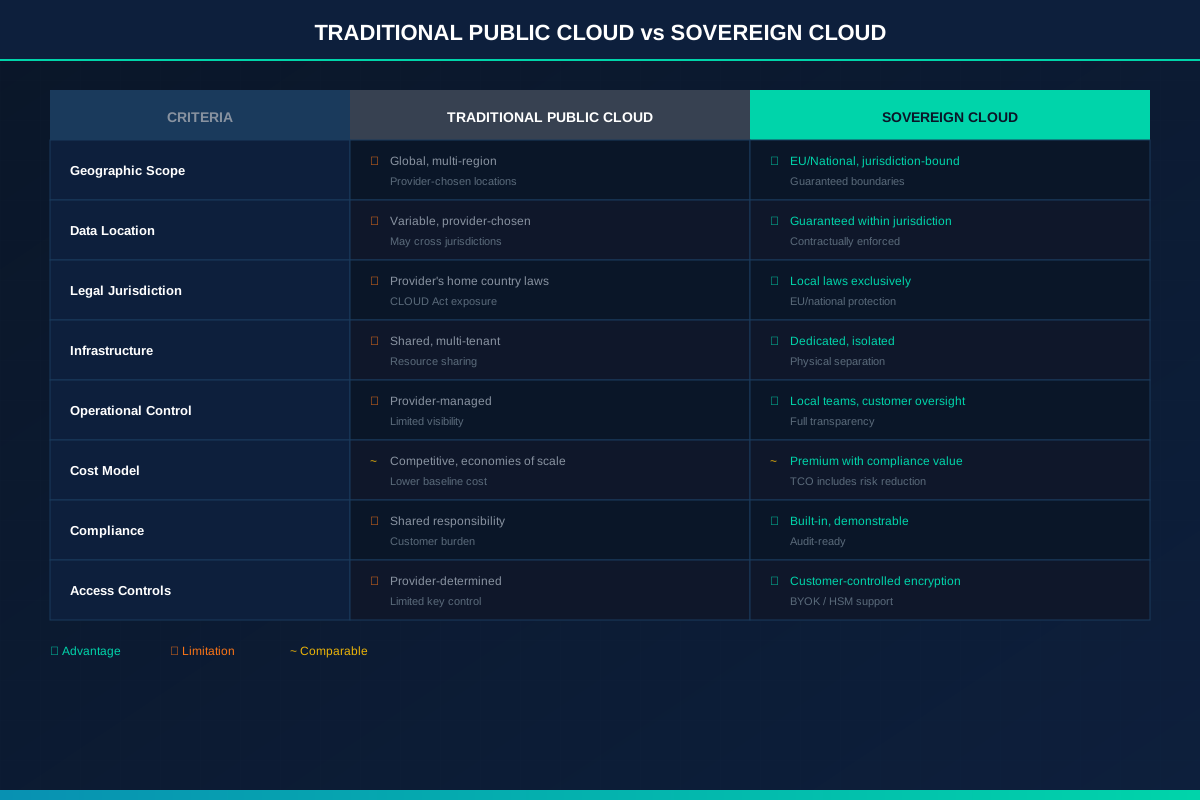
This comprehensive comparison table contrasts Traditional Public Cloud with Sovereign Cloud across eight critical criteria. The table uses a three-column layout with color coding reinforcing the evaluation—red X symbols for disadvantages, green checkmarks for advantages, and yellow tildes for comparable aspects. Each row addresses Geographic Scope, Data Location, Legal Jurisdiction, Infrastructure, Operational Control, Cost Model, Compliance, and Access Controls.
Key Points:
- Traditional public cloud offers multi-region flexibility but lacks jurisdictional guarantees
- Sovereign cloud provides contractually enforced data location within specific jurisdictions
- Legal jurisdiction differences expose traditional cloud to CLOUD Act and foreign laws
- Cost models vary: economies of scale vs. premium pricing with compliance value
- Compliance burden shifts from customer responsibility to built-in, audit-ready systems
Additional Context: The CLOUD Act (Clarifying Lawful Overseas Use of Data Act), passed by the US in 2018, grants US law enforcement agencies the right to compel US-based technology companies to produce data stored on servers regardless of location. This extraterritorial reach fundamentally conflicts with EU data protection principles enshrined in GDPR, creating legal uncertainty for European organizations using US cloud providers.
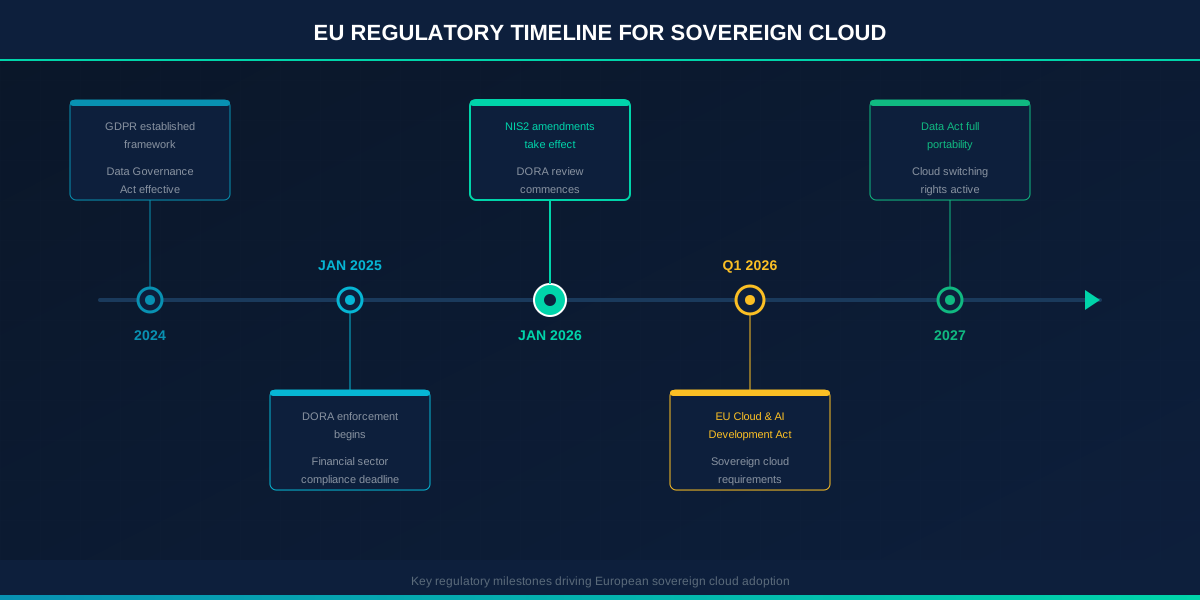
This horizontal timeline diagram maps five key regulatory milestones driving European sovereign cloud adoption from 2024 to 2027. The timeline is represented by a gradient teal line with circular nodes marking each milestone. Events alternate above and below the timeline, with the 2026 milestone highlighted with a larger, brighter node emphasizing its critical importance as the pivotal year when multiple regulations converge.
Key Milestones:
- 2024: GDPR framework established, Data Governance Act becomes effective
- January 2025: DORA (Digital Operational Resilience Act) enforcement begins for financial sector
- January 2026: NIS2 amendments take effect, DORA review commences (highlighted as pivotal)
- Q1 2026: EU Cloud & AI Development Act introduces sovereign cloud requirements
- 2027: Data Act full portability and cloud switching rights become active
Additional Context: DORA (effective January 17, 2025) specifically targets financial entities, imposing strict requirements for ICT risk management and third-party oversight. NIS2 expands to cover more sectors (energy, transport, healthcare, public administration) with more stringent security requirements. The Data Act mandates that cloud providers offer switching mechanisms within 30 days, fundamentally altering cloud business models.
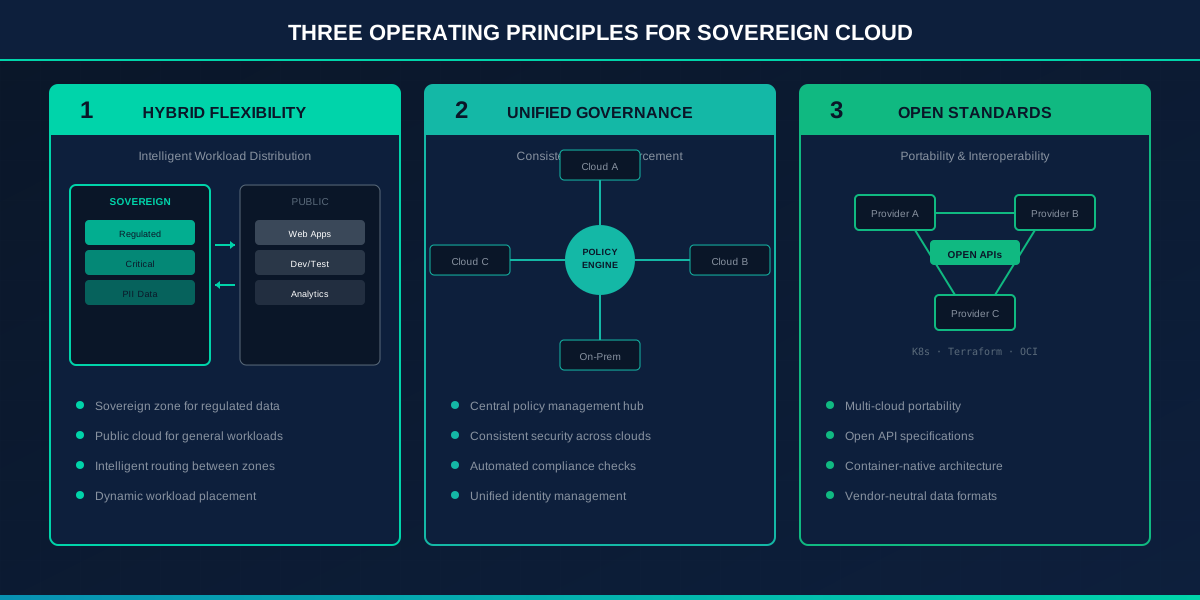
This three-panel infographic illustrates the operational principles that enable effective sovereign cloud implementation. Each panel presents a distinct principle with visual metaphors demonstrating how organizations can achieve sovereignty while maintaining flexibility and avoiding vendor lock-in.
Key Points:
- Hybrid Flexibility: Workloads are intelligently distributed between sovereign cloud (highlighted with security borders) and public cloud regions, with smart routing ensuring data sovereignty requirements are met while optimizing for performance and cost
- Unified Governance: A central control panel radiates security policies, compliance rules, and access controls to multiple cloud environments, ensuring consistent policy enforcement regardless of infrastructure location
- Open Standards: Puzzle pieces representing different cloud providers connect seamlessly through open APIs, Kubernetes, and standardized data formats, enabling true portability and preventing vendor lock-in
- The three principles work interdependently to create a balanced sovereign cloud strategy
Additional Context: These operating principles reflect the practical reality that most organizations cannot adopt an all-or-nothing approach to sovereign cloud. Hybrid flexibility allows sensitive workloads to run in sovereign regions while less critical services leverage standard public cloud economics. Unified governance ensures that even in hybrid environments, security and compliance policies are consistently enforced. Open standards future-proof the architecture by ensuring that organizations retain the ability to change providers without massive re-architecting efforts.
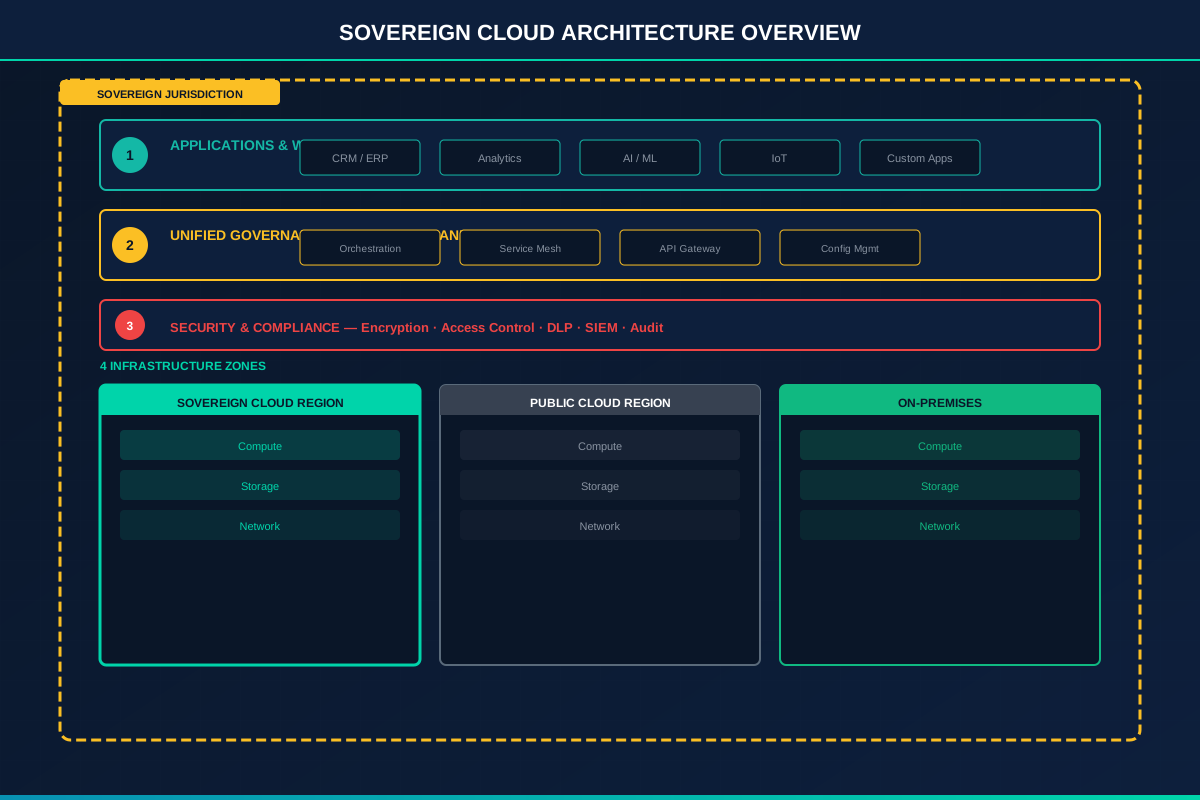
This comprehensive enterprise architecture diagram illustrates a complete hybrid sovereign cloud architecture with three distinct infrastructure zones managed through a unified control plane. The layered approach shows how applications, governance, and infrastructure components interact across sovereign, public, and on-premises environments.
Key Points:
- Application Layer: Business applications and workloads operate independently of underlying infrastructure, enabling flexibility in deployment decisions
- Unified Governance Layer: Spans across all environments, enforcing consistent security policies, identity management, access controls, and compliance monitoring regardless of where workloads run
- Infrastructure Layer: Three zones operate side-by-side: Sovereign Cloud Region (highlighted with protective border for sensitive data), Public Cloud Region (for non-sensitive workloads), and On-Premises Infrastructure (for legacy systems)
- Data flows are visualized with arrows showing encryption in transit, while security policy enforcement is illustrated radiating from the governance layer
- Icons represent key capabilities: encryption, access control, monitoring, and compliance auditing
Additional Context: This architecture reflects the reality that most large European enterprises operate in hybrid environments with a mix of legacy on-premises systems, existing public cloud investments, and new sovereign cloud requirements. The unified governance layer is critical—it ensures that whether data resides in a sovereign region for regulatory compliance or in a public cloud for cost optimization, the same security and compliance controls apply. This approach also enables gradual migration, allowing organizations to move workloads to sovereign regions on a schedule that makes business sense rather than requiring a disruptive "big bang" migration.
The Regulatory Landscape
EU framework, CLOUD Act challenges, and industry-specific requirements
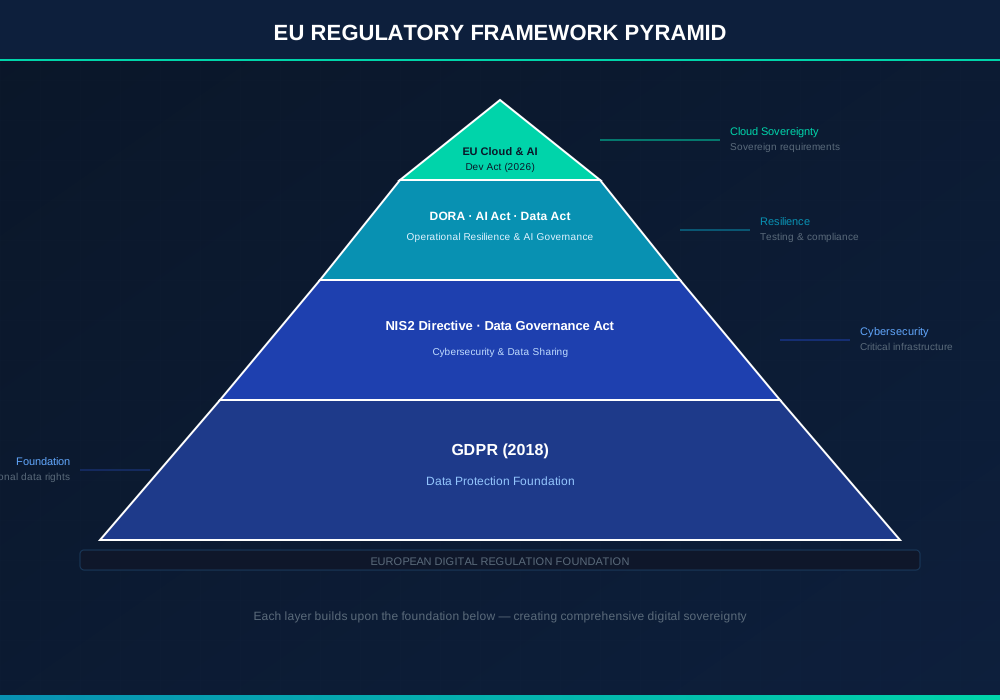
This pyramid diagram visualizes the layered structure of EU digital regulations, showing how each successive regulatory framework builds upon and extends previous legislation. The pyramid structure emphasizes the foundational role of GDPR while illustrating how newer regulations address increasingly specific sovereignty, security, and technology governance concerns.
Key Points:
- Foundation Layer (2018): GDPR establishes baseline data protection and privacy rights across the EU, creating the fundamental framework for all subsequent regulations
- Second Layer (2022-2023): NIS2 Directive extends cybersecurity requirements to more sectors, while Data Governance Act facilitates data sharing and reuse within legal boundaries
- Third Layer (2024-2025): DORA enforces operational resilience for financial services, AI Act regulates artificial intelligence systems, and Data Act enables data portability and cloud switching rights
- Top Layer (2026): EU Cloud & AI Development Act introduces explicit sovereign cloud requirements and establishes framework for European AI development
- Side annotations indicate each layer's primary focus: data protection, cybersecurity, operational resilience, AI governance, and cloud sovereignty
Additional Context: The pyramid structure is deliberate—each layer depends on and extends the layers beneath it. GDPR's data protection principles form the legal foundation, but alone they proved insufficient to address cloud sovereignty concerns. NIS2 added cybersecurity mandates, DORA introduced operational resilience requirements for critical sectors, and the AI Act addressed algorithmic governance. The 2026 Cloud & AI Development Act represents the culmination of this regulatory evolution, explicitly mandating sovereign cloud capabilities for EU-based infrastructure serving critical sectors. Organizations must comply with all layers simultaneously, not just the most recent regulations.
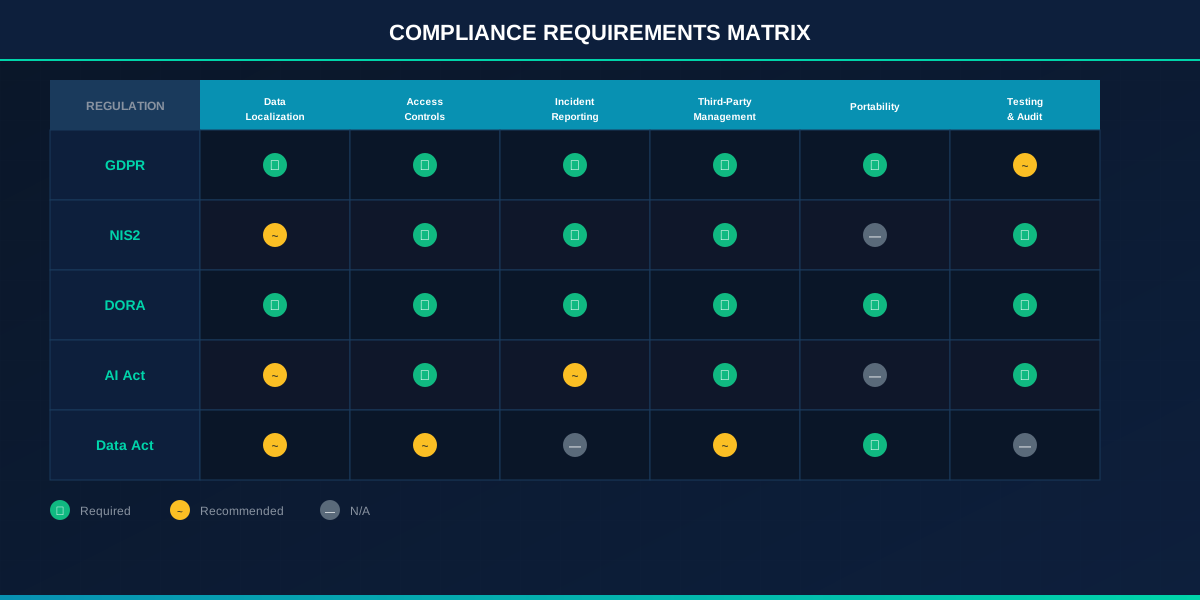
This comprehensive matrix maps five major EU regulations against six critical compliance requirements, providing a visual overview of where each regulation mandates or recommends specific controls. The color-coded cells enable quick assessment of compliance obligations across the regulatory landscape.
Key Points:
- GDPR: Requires access controls and incident reporting, recommends data localization for high-risk processing, mandates portability rights
- NIS2: Requires incident reporting within 24 hours, mandates third-party risk management, requires security testing and audits for essential entities
- DORA: Explicitly requires third-party ICT provider management, incident reporting protocols, and comprehensive testing regimes for financial institutions
- AI Act: Requires data governance controls for high-risk AI systems, mandates technical documentation and conformity assessments
- Data Act: Mandates data portability between cloud providers, requires 30-day switching mechanisms, enforces transparent access to data
- Color coding clarifies obligation levels: green indicates "Required" with legal mandate, yellow shows "Recommended" for best practices, and gray marks "N/A" where regulation doesn't address the requirement
Additional Context: This matrix reveals critical overlap areas where multiple regulations impose similar requirements—for instance, both GDPR and DORA require incident reporting, but with different timelines and scope. Organizations must comply with the most stringent requirement where regulations overlap. The matrix also highlights gaps—for example, while GDPR recommends data localization, NIS2 and DORA effectively require it for critical infrastructure and financial services through their operational resilience mandates. Understanding these overlaps and gaps is essential for designing a sovereign cloud architecture that satisfies all applicable regulations simultaneously rather than implementing point solutions for each regulation individually.
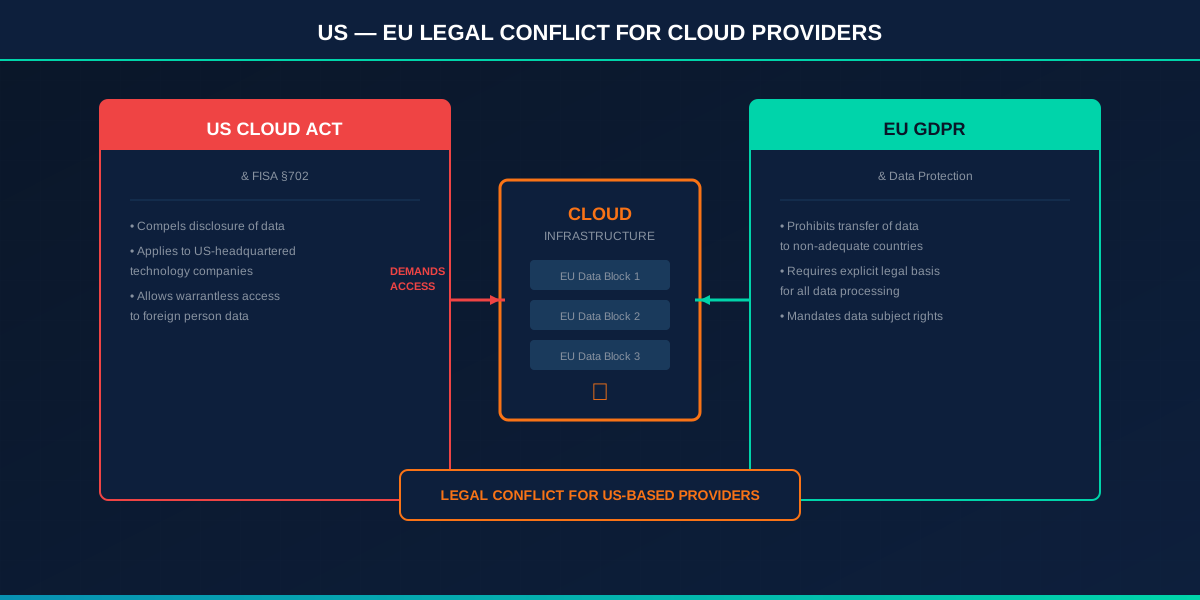
This diagram illustrates the fundamental legal conflict between US extraterritorial data access laws and EU data protection principles. The visual uses opposing arrows and contrasting national colors to depict how US-based cloud providers face irreconcilable legal obligations when serving European customers.
Key Points:
- Left Side (US CLOUD Act): US flag-colored arrow represents US law enforcement demands for data access, showing how the 2018 CLOUD Act grants US authorities extraterritorial reach to compel US companies to produce data regardless of where it's stored
- Center (Cloud Infrastructure): Data servers positioned on a European map symbolize EU-located infrastructure that remains subject to US legal jurisdiction when operated by US-based providers
- Right Side (EU GDPR): EU flag-colored barrier represents GDPR's data protection requirements, particularly Article 48 which prohibits data transfers based on foreign legal requests without EU legal approval
- Tension is visualized through warning symbols, conflict icons, and opposing directional forces creating an impossible position for US-based providers
- Text annotation highlights: "Legal Conflict for US-based Providers—Cannot Comply with Both Simultaneously"
Additional Context: The conflict stems from fundamentally incompatible legal philosophies. The US CLOUD Act asserts jurisdiction based on corporate nationality (if you're a US company, US law follows you globally), while GDPR asserts jurisdiction based on data subject location (if you process EU residents' data, EU law applies). This creates an impossible situation: a US cloud provider operating EU data centers can be legally compelled by US authorities to provide data in violation of GDPR, exposing them to massive EU penalties (up to 4% of global revenue). The Schrems II decision by the Court of Justice of the European Union explicitly addressed this conflict, invalidating Privacy Shield and requiring supplementary measures that are difficult or impossible to implement with US-based providers. Sovereign cloud offerings from European providers or through legally independent EU entities resolve this conflict by removing US legal jurisdiction entirely.
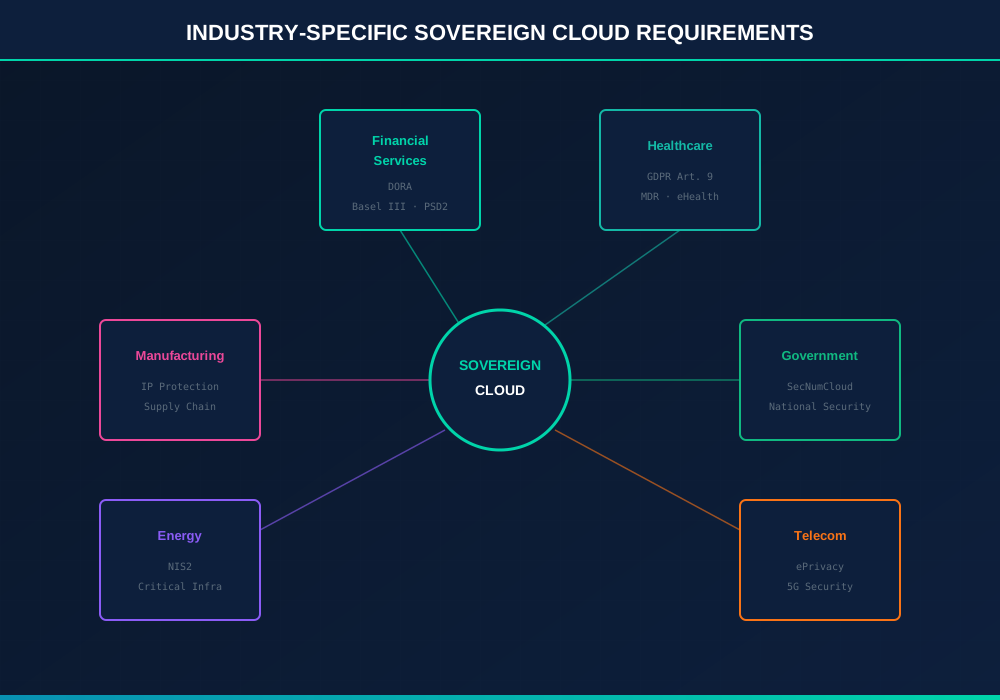
This radial wheel diagram positions "SOVEREIGN CLOUD" at the center with six industry segments extending outward, each displaying distinct regulatory drivers and compliance requirements. The visual emphasizes how sovereign cloud serves as a common solution addressing diverse industry-specific regulatory obligations.
Key Points:
- Financial Services: Subject to DORA (Digital Operational Resilience Act, effective January 2025), Basel III capital requirements for operational risk, and PSD2 strong customer authentication; sovereignty ensures operational resilience and third-party risk management
- Healthcare: Must comply with GDPR Article 9 (special category health data requiring enhanced protection), Medical Device Regulation (MDR), and emerging eHealth network requirements; sovereign infrastructure protects highly sensitive patient data
- Government: Requires SecNumCloud certification in France, national security classifications across EU member states, and public sector-specific data residency mandates; sovereignty is non-negotiable for government workloads
- Telecommunications: Governed by ePrivacy Directive, 5G security toolbox requirements, and NIS2 as designated essential entities; sovereign cloud ensures network independence and resilience
- Energy: Designated critical infrastructure under NIS2, subject to sector-specific cybersecurity requirements and operational technology (OT) security standards; sovereignty protects critical national infrastructure
- Manufacturing: Driven by intellectual property protection concerns, supply chain security requirements, and Industry 4.0 data sovereignty; sovereign cloud prevents technology transfer and IP theft
Additional Context: While sovereign cloud is often discussed in terms of cross-sector regulations like GDPR and NIS2, industry-specific requirements often provide the strongest drivers for adoption. Financial services firms face explicit mandates under DORA to ensure their ICT third-party providers (including cloud providers) meet resilience standards that are most reliably achieved through sovereign offerings. Healthcare organizations processing special category data under GDPR Article 9 find that contractual guarantees from non-EU providers are insufficient to satisfy regulatory requirements. Government agencies in countries like France have explicit national sovereignty requirements that cannot be met by hyperscaler offerings. The wheel structure emphasizes that sovereign cloud is not a single-industry solution but rather a horizontal platform addressing vertical industry requirements.
The Business Case
Market opportunity, benefits, industry value, and ROI framework
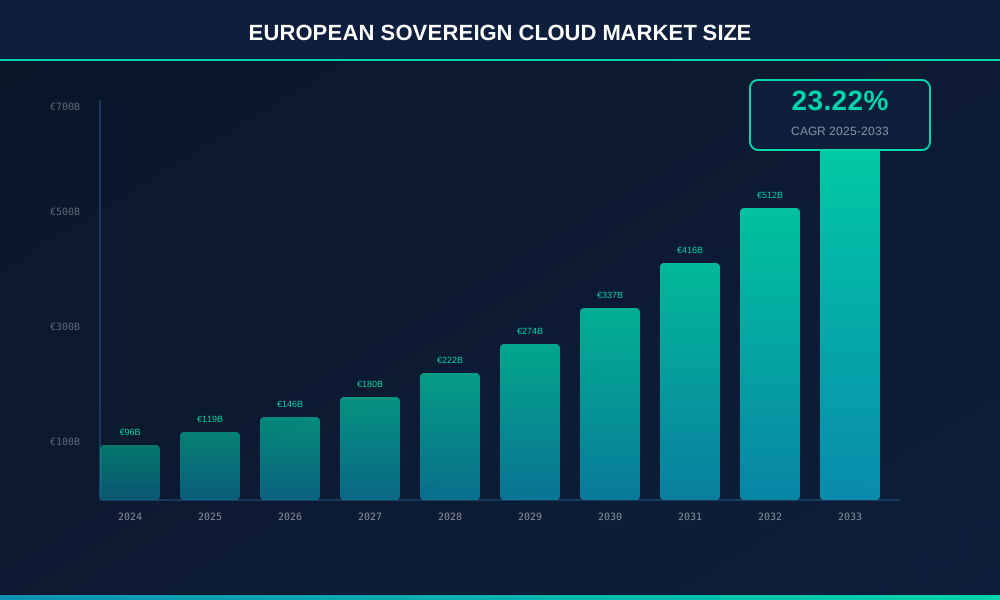
This professional financial growth chart visualizes the explosive expansion of the sovereign cloud market from 2024 through 2033, with a prominent vertical marker highlighting 2026 as the regulatory inflection point. The upward curve demonstrates accelerating adoption as regulations take effect and market maturity increases.
Key Points:
- 2024 Baseline: €96.35 billion market, representing early adopters primarily in government and highly regulated sectors
- 2025 Growth: €118.72 billion (23% year-over-year growth) as DORA takes effect for financial services
- 2026 Inflection Point: Marked with prominent vertical line and annotation, representing convergence of NIS2 amendments, DORA review, and emerging EU Cloud & AI Development Act; estimated ~€180 billion
- 2030 Acceleration: Projected ~€350 billion as sovereign cloud becomes standard for European enterprises in regulated sectors
- 2033 Market Maturity: €630.93 billion, representing a 23.22% compound annual growth rate (CAGR) over the entire period
- Gradient fill and trend acceleration visualization emphasize the non-linear growth pattern, with steepest growth occurring post-2026
Additional Context: The 23.22% CAGR significantly exceeds overall cloud market growth rates (typically 15-18% CAGR), indicating sovereign cloud is capturing share from traditional public cloud providers. The 2026 inflection point is not arbitrary—it represents the year when regulatory requirements shift from "nice to have" contractual assurances to mandatory architectural sovereignty. Market research from multiple sources (Mordor Intelligence, Market Research Future, IDC) converge on similar growth projections, driven by three factors: regulatory enforcement actions creating compliance urgency, geopolitical tensions accelerating European digital autonomy initiatives, and maturing sovereign cloud offerings from major providers making adoption more practical. The market size includes not just infrastructure costs but also migration services, compliance consulting, and sovereign cloud-native application development—representing a comprehensive ecosystem opportunity.
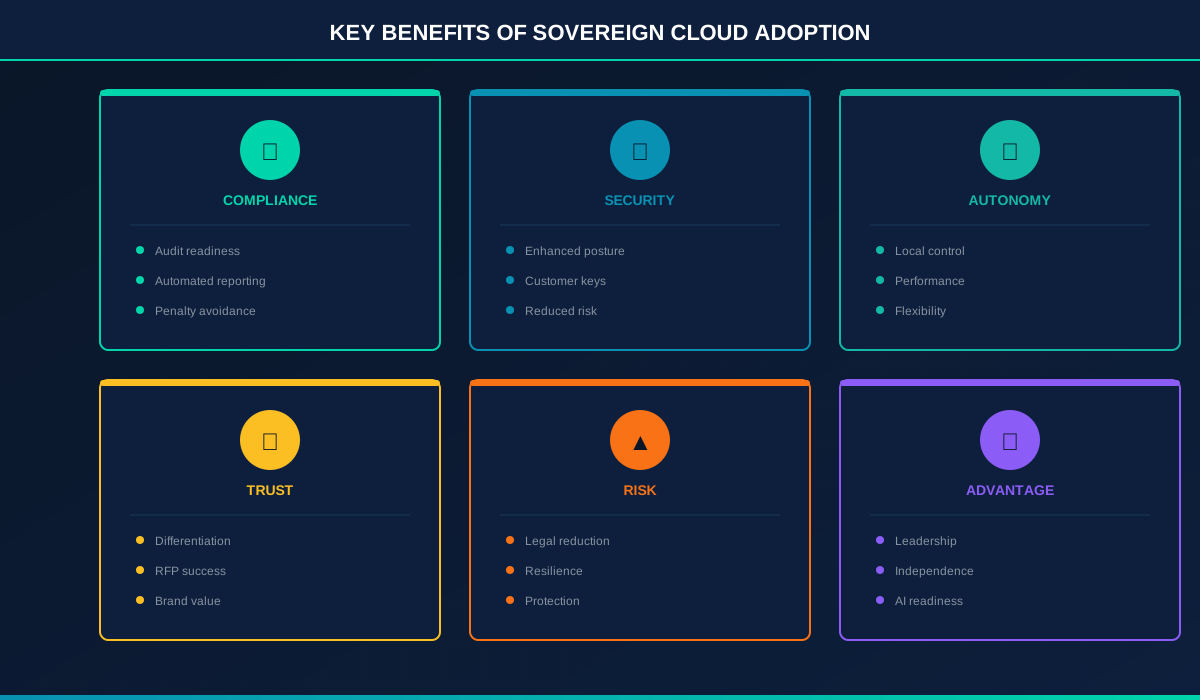
This icon-based infographic presents six strategic benefits of sovereign cloud adoption arranged in a balanced grid or radial pattern. Each benefit is represented by a distinct icon and detailed with specific value propositions, illustrating how sovereign cloud delivers value beyond mere regulatory compliance.
Key Points:
- COMPLIANCE ASSURANCE (checkmark shield icon): Demonstrable audit readiness with architecture-level compliance, automated compliance reporting reducing manual effort, and penalty avoidance (GDPR fines can reach 4% of global revenue or €20 million)
- SECURITY & CONTROL (lock with key icon): Enhanced security posture through jurisdictional protection, customer-controlled encryption keys (BYOK/HYOK) ensuring no provider access, and reduced foreign surveillance risk by operating outside CLOUD Act jurisdiction
- OPERATIONAL AUTONOMY (control panel icon): Local operational control with EU-based personnel, performance advantages from regional data centers with low latency, and strategic flexibility to adapt to changing regulations without vendor dependencies
- CUSTOMER TRUST (handshake icon): Market differentiation in competitive RFPs where sovereignty is increasingly required, RFP success (many government and enterprise RFPs now mandate sovereign capabilities), and enhanced brand value as a trusted data steward
- RISK MITIGATION (umbrella/protection icon): Legal risk reduction by resolving US-EU jurisdictional conflicts, operational resilience through dedicated infrastructure and support, and reputational protection against data breach headlines
- COMPETITIVE ADVANTAGE (trophy/star icon): Market leadership positioning in European digital sovereignty movement, strategic independence from non-EU technology dependencies, and AI readiness as sovereign AI becomes the next regulatory frontier
Additional Context: These benefits represent both defensive (risk mitigation, compliance) and offensive (competitive advantage, customer trust) value propositions. Organizations often begin their sovereign cloud journey for defensive reasons—avoiding GDPR penalties or satisfying a specific regulatory requirement—but discover offensive benefits become more valuable over time. Customer trust, for instance, translates directly to revenue when enterprises choose vendors who can demonstrate true data sovereignty in competitive evaluations. Operational autonomy provides resilience against geopolitical disruptions, as witnessed during various US-China technology conflicts. The AI readiness benefit is forward-looking: as AI training data becomes subject to increasingly strict sovereignty requirements, organizations with established sovereign cloud infrastructure will have a significant first-mover advantage in deploying compliant AI systems.
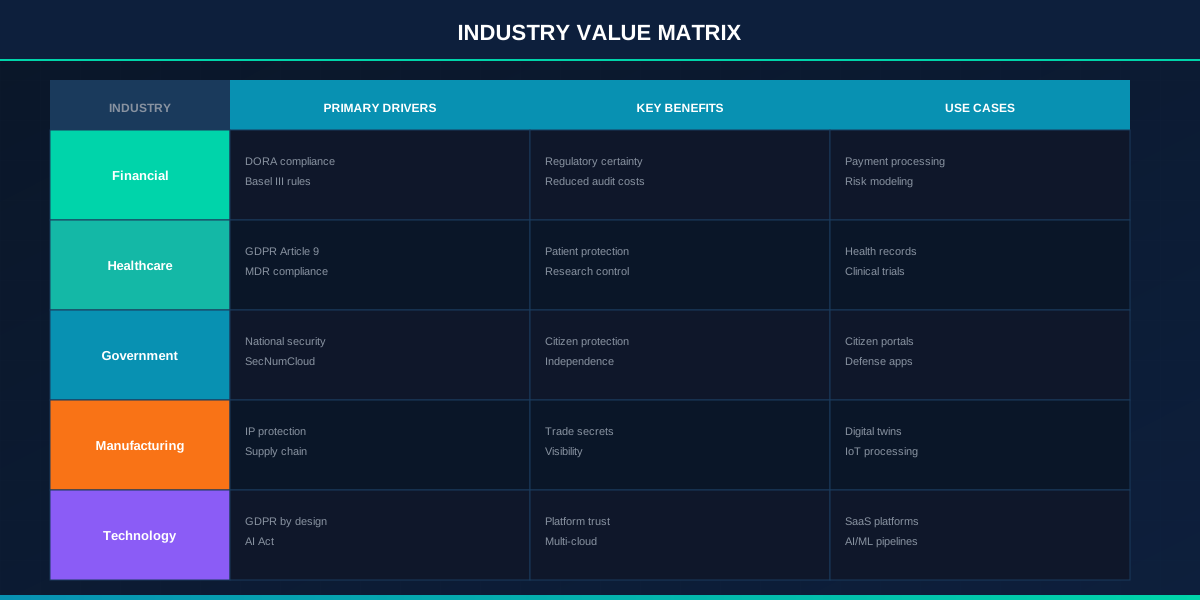
This comprehensive matrix maps five key industries against their specific sovereign cloud drivers, benefits, and use cases. The table format with industry icons and alternating row colors enables quick identification of industry-relevant value propositions and implementation patterns.
Key Points:
- Financial Services: Primary drivers include DORA compliance, third-party risk management, and operational resilience requirements; key benefits are automated compliance reporting, reduced audit burden, and penalty avoidance; typical use cases include core banking systems, payment processing, risk analytics, and customer data platforms
- Healthcare: Driven by GDPR Article 9 special category data protections, patient privacy regulations, and medical device security requirements; benefits include patient trust, research data sovereignty, and clinical trial compliance; use cases span electronic health records (EHR), medical imaging storage, genomic data processing, and telemedicine platforms
- Government: Primary drivers are national security mandates, public sector data residency requirements, and digital sovereignty policies; benefits include citizen trust, inter-agency data sharing within legal boundaries, and resistance to foreign surveillance; use cases include citizen identity systems, law enforcement databases, national infrastructure monitoring, and digital public services
- Manufacturing: Driven by intellectual property protection, Industry 4.0 data sovereignty, and supply chain security concerns; benefits include prevention of technology transfer, competitive intelligence protection, and supply chain resilience; use cases include CAD/CAM design data, IoT sensor data from production lines, predictive maintenance analytics, and supplier collaboration platforms
- Technology: Drivers include competitive differentiation, customer data sovereignty requirements, and SaaS platform compliance; benefits include market access to regulated customers, trust-based differentiation, and reduced liability; use cases include SaaS application hosting, development and testing environments, customer data processing, and AI/ML model training
Additional Context: The industry-specific patterns reveal that while regulations provide the initial driver, practical benefits vary significantly by sector. Financial services organizations emphasize operational resilience and audit efficiency because they face frequent regulatory examinations. Healthcare prioritizes patient trust and research collaboration, as these directly impact their ability to conduct multi-institutional studies under GDPR constraints. Government agencies focus on citizen trust and inter-agency cooperation, recognizing that sovereignty enables data sharing that would be legally problematic with foreign providers. Manufacturing firms value IP protection above compliance, viewing sovereignty as competitive defense. Technology companies see sovereign cloud as a market access enabler, unlocking enterprise and government customers who would otherwise be legally unable to use their platforms. Understanding these industry-specific motivations is essential for positioning sovereign cloud solutions effectively.
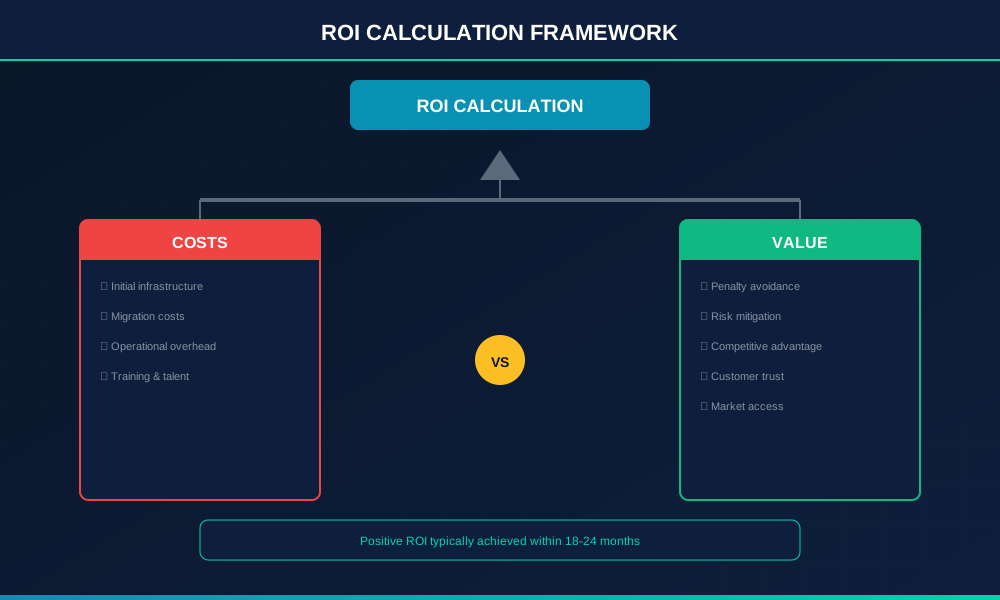
This balanced diagram presents a comprehensive ROI calculation framework for sovereign cloud adoption, with costs on the left side and value/benefits on the right, converging on a central ROI calculation methodology. The visual hierarchy demonstrates how long-term benefits outweigh initial investments through specific, quantifiable value drivers.
Key Points:
- Initial Infrastructure Investment (15-30% premium): Sovereign cloud typically costs 15-30% more than comparable public cloud resources due to dedicated infrastructure, but provides guaranteed compliance architecture
- Migration Costs (one-time): Application refactoring, data transfer, testing and validation, temporary dual-operation during migration; typically 10-20% of annual infrastructure spend
- Operational Overhead (5-10% ongoing): Additional governance processes, compliance monitoring, and documentation requirements specific to sovereign environments
- Training & Talent (upfront investment): Staff training on sovereign cloud architecture, hiring specialists with EU regulatory expertise, partner ecosystem development
- Penalty Avoidance (massive downside protection): GDPR penalties up to 4% of global revenue or €20 million; single avoided penalty can justify years of sovereignty investment
- Risk Mitigation (unquantifiable but real): Reduced legal risk from jurisdictional conflicts, operational resilience against geopolitical disruptions, reputational protection from data sovereignty incidents
- Competitive Advantage (revenue enabler): Access to tenders requiring sovereignty, faster RFP cycles, premium pricing for compliant services, first-mover advantage in sovereign AI
- Customer Trust (customer retention + acquisition): Reduced churn from compliance-sensitive customers, new customer acquisition in regulated sectors, brand value as trusted data steward
- Market Access (market expansion): Ability to serve government customers, expansion into highly regulated sectors, European market preference advantages
Additional Context: The ROI calculation for sovereign cloud differs fundamentally from typical infrastructure investments because much of the value comes from avoiding negative outcomes (penalties, customer loss, reputation damage) rather than generating positive returns. A single GDPR penalty—even at a fraction of the maximum—can exceed the total cost of sovereign cloud implementation. For example, Amazon was fined €746 million in 2021; British Airways £20 million in 2020. Beyond penalty avoidance, competitive advantage becomes the primary ROI driver over time. Organizations report that sovereign cloud capabilities enable them to compete for business previously inaccessible due to compliance requirements. The framework emphasizes that ROI should be calculated over 3-5 years, not annually, as migration costs are front-loaded while benefits accumulate over time. Additionally, the framework should include "option value"—the strategic flexibility to adapt to future regulatory changes without requiring another major infrastructure transformation.
Technical Architecture
Core components, architectural patterns, and implementation principles
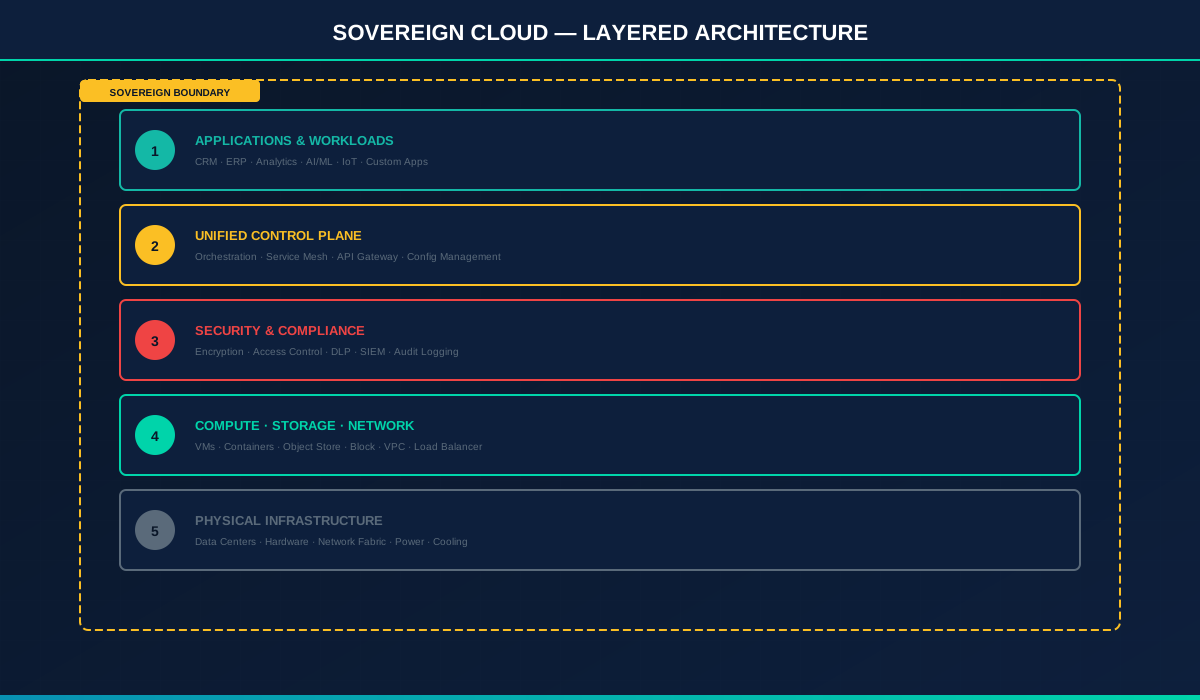
This comprehensive layered architecture diagram illustrates the complete technical stack of a sovereign cloud implementation, from physical infrastructure through applications, with all layers contained within a sovereign jurisdiction boundary. The architecture emphasizes customer control at every level and shows how different components interact while maintaining sovereignty guarantees.
Key Points:
- Layer 5 (Foundation) - Physical Infrastructure: Data centers physically located within EU/national jurisdiction, with facilities, power, cooling, and network connectivity all under local control and subject to local law only
- Layer 4 - Compute, Storage, Network: Dedicated sovereign resources including compute instances, block/object storage, and network fabric, all isolated from multi-tenant global infrastructure
- Layer 3 - Security & Compliance Layer: Encryption (data at rest and in transit), access controls (role-based and attribute-based), continuous monitoring, and compliance enforcement mechanisms operating across all resources
- Layer 2 - Unified Control Plane: Customer-owned management layer providing single pane of glass for provisioning, monitoring, and governance across sovereign infrastructure; this layer is critical for ensuring customer—not provider—maintains operational control
- Layer 1 (Top) - Applications & Workloads: Business applications, databases, analytics platforms, and AI/ML workloads running with guaranteed sovereignty throughout the stack
- Side Panel - Key Management: Customer-controlled encryption key management (BYOK/HYOK models), ensuring provider has no access to encrypted data; keys never leave sovereign boundary
- Side Panel - Identity & Access Management: Federated identity integration, multi-factor authentication, privileged access management, all enforced within sovereign jurisdiction
- Side Panel - Audit & Logging: Comprehensive audit trails, security event logging, compliance reporting, and forensic capabilities maintained within jurisdiction for legal discovery
- Sovereign Jurisdiction Boundary: Visual border encompasses entire stack, emphasizing that no component, data, or control mechanism extends beyond the defined legal jurisdiction
Additional Context: This layered architecture reflects the "defense in depth" approach necessary for true sovereignty. Each layer contributes to sovereignty guarantees: physical infrastructure ensures no foreign physical access, dedicated resources prevent data commingling, security controls enforce policy, customer-owned control planes prevent provider override, and side-panel capabilities (key management, IAM, audit) ensure complete customer control. The architecture explicitly avoids "sovereignty theater"—superficial measures like data residency without operational sovereignty. For example, many cloud providers offer "data residency" by storing data in EU regions while retaining administrative control through global management planes—this architecture instead requires the management plane itself to be sovereign. The customer-owned control plane is particularly critical: it ensures that even the provider cannot access resources without customer-initiated action. This architecture pattern is increasingly mandated by regulations like DORA, which require financial institutions to demonstrate operational control over their critical ICT services, not just contractual assurances from providers.
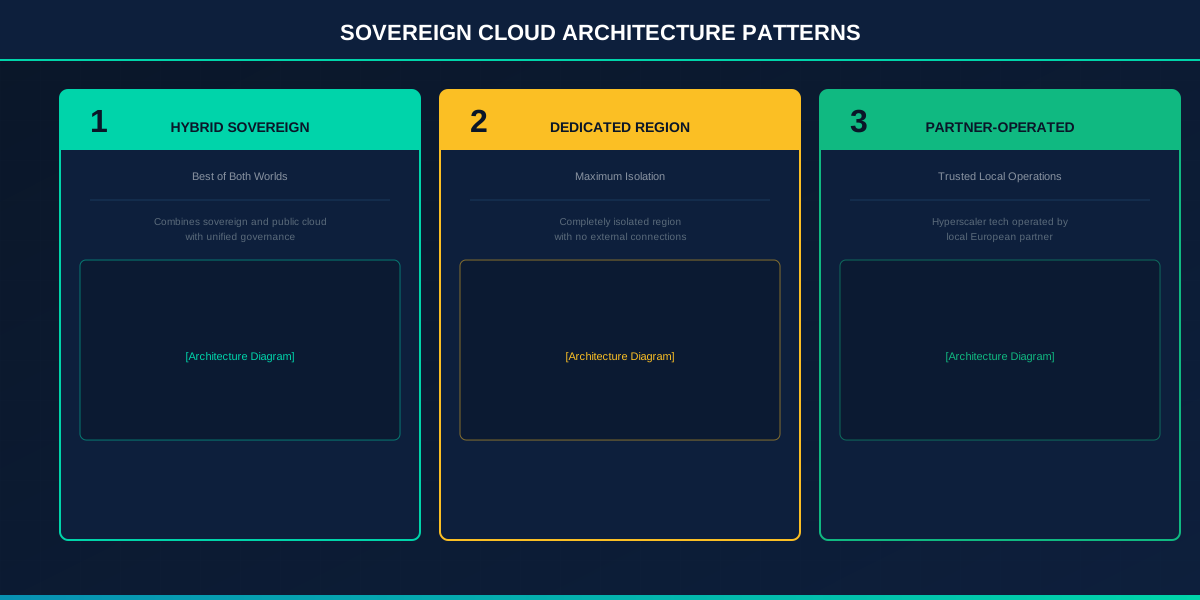
This three-panel diagram presents distinct architectural patterns for implementing sovereign cloud, showing how organizations can choose different approaches based on their specific sovereignty requirements, existing infrastructure, and operational preferences. Each pattern represents a legitimate sovereignty model with different trade-offs between isolation, flexibility, and ecosystem compatibility.
Key Points:
- Pattern 1 - Hybrid Sovereign Cloud: Combines sovereign cloud region (highlighted with protective border in blue/gold) with standard public cloud region (gray), connected through unified governance layer; workloads are intelligently distributed based on sovereignty requirements, with sensitive data in sovereign region and non-regulated workloads in cost-optimized public cloud; unified policy engine ensures consistent security and compliance across both environments; best for organizations with mixed workload sensitivity and cost optimization needs
- Pattern 2 - Dedicated Sovereign Region: Completely isolated sovereign environment with strong boundary, no connections to global cloud infrastructure; all services, data, and management operate entirely within sovereign jurisdiction; air-gapped architecture ensures maximum sovereignty and security; best for government, defense, critical infrastructure, and organizations with absolute sovereignty mandates; trade-off is reduced service breadth and higher costs due to dedicated infrastructure
- Pattern 3 - Partner-Operated Model: Hyperscaler technology stack (labeled with original brand) operated by legally independent local partner organization (different entity entirely); clear visual separation between technology layer (provided by hyperscaler) and operations layer (controlled by EU-based partner); legal structure ensures operational control and data access remain within EU jurisdiction while leveraging established cloud technology; examples include Microsoft Cloud for Sovereignty with T-Systems, Oracle with various European partners; resolves jurisdictional conflicts while maintaining technology compatibility
- Visual consistency across all three patterns uses boundaries/borders to demarcate sovereignty zones, data center icons to represent infrastructure, and workload symbols to show application placement
- Color coding consistently applies blue/gold for sovereign zones, gray for non-sovereign regions, and green for on-premises infrastructure
Additional Context: These patterns represent the spectrum of sovereign cloud implementation approaches emerging in the European market. The Hybrid Sovereign Cloud pattern is increasingly popular as organizations realize not all workloads require the same level of sovereignty—marketing websites and development environments can run in standard regions while customer PII and financial transactions run in sovereign regions. The Dedicated Sovereign Region pattern represents the highest sovereignty guarantee but with significant cost and complexity premiums; it's typically chosen by organizations with legal mandates (government agencies) or extreme risk profiles (defense contractors). The Partner-Operated Model attempts to solve the "hyperscaler dilemma"—organizations want AWS/Azure/Google technology and ecosystem but need to escape US legal jurisdiction. By placing legal operational control with an EU-based partner, these models theoretically resolve CLOUD Act conflicts while maintaining technical compatibility. However, this pattern faces ongoing legal scrutiny, with some regulators questioning whether technology dependency on US providers constitutes sufficient sovereignty. Organizations should choose patterns based on specific regulatory requirements, risk tolerance, budget constraints, and technical ecosystem needs rather than assuming one pattern fits all scenarios.
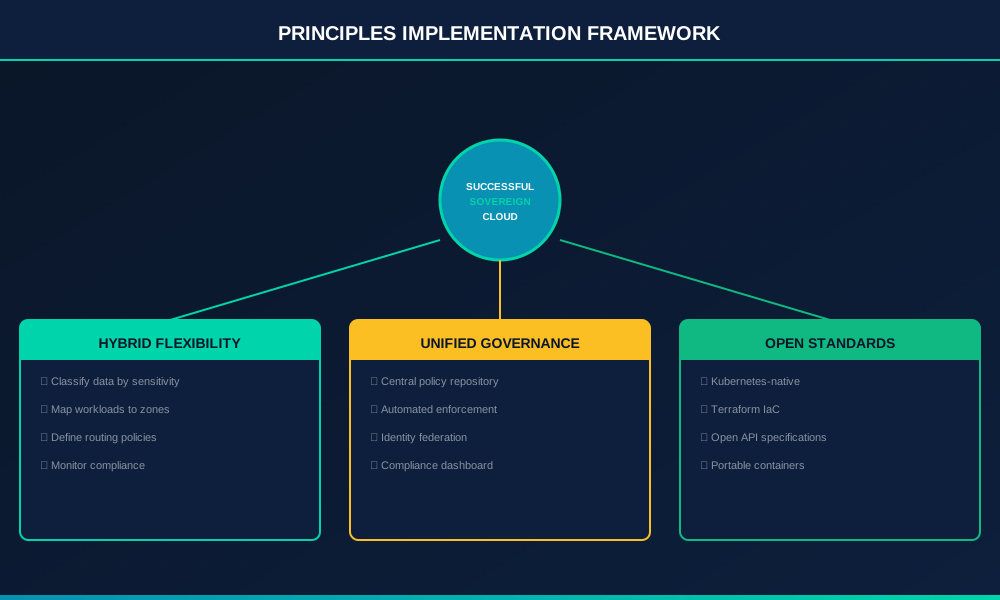
This framework diagram illustrates how the three core operating principles—Hybrid Flexibility, Unified Governance, and Open Standards—work together synergistically to enable successful sovereign cloud implementation. The central hub-and-spoke design emphasizes that these principles are not independent capabilities but interconnected elements of a cohesive strategy.
Key Points:
- Central Hub - "Successful Sovereign Cloud Implementation": Represents the desired outcome that can only be achieved when all three principles are implemented in concert, not individually
- Branch 1 - Hybrid Flexibility: Illustrated with decision tree showing workload classification criteria: data sensitivity (public, internal, confidential, restricted), regulatory requirements (GDPR only, NIS2, DORA, sector-specific), performance requirements (latency-sensitive, throughput-optimized), and cost constraints (budget-constrained, cost-optimized, premium); decision tree routes workloads to appropriate infrastructure (sovereign, public, on-premises) based on these factors
- Branch 2 - Unified Governance: Shows central policy engine with radiating policy enforcement to multiple environments; policies include data classification and handling, access control and authentication, encryption and key management, audit and compliance monitoring, incident response procedures; same policies apply consistently whether workload runs in sovereign cloud, public cloud, or on-premises
- Branch 3 - Open Standards: Depicts portability mechanisms between providers using standardized technologies: containerization (Kubernetes, Docker), infrastructure as code (Terraform, Ansible), open data formats (JSON, Parquet, not proprietary formats), standard APIs (REST, GraphQL, not vendor-specific), and portable databases (PostgreSQL, not Aurora/CosmosDB); arrows show bidirectional movement capability between providers
- Checkboxes or validation criteria for each principle ensure implementation completeness: Hybrid Flexibility checked when workload classification framework exists, Unified Governance checked when policies apply across all environments, Open Standards checked when architecture avoids vendor-specific services
- Visual hierarchy flows from principles to central implementation success, showing that mastery of all three principles is prerequisite for success
Additional Context: This framework challenges the common misconception that sovereign cloud is simply about choosing the right provider or region. Instead, successful implementation requires organizational capabilities across three dimensions. Hybrid Flexibility requires mature workload classification and placement decision-making—many organizations struggle here because they lack clear data classification frameworks or try to apply one-size-fits-all approaches. Unified Governance is perhaps the most difficult principle to implement because it requires policy engines that can abstract across different infrastructure types while enforcing consistent controls—tool fragmentation (different IAM systems, different logging systems) undermines this principle. Open Standards demands architectural discipline to avoid vendor-specific services even when they offer short-term convenience—organizations must actively resist lock-in rather than passively hoping for portability. The framework is inspired by enterprise architecture practices and cloud operating models from organizations like FinOps Foundation and Cloud Security Alliance, adapted specifically for sovereign cloud context. Implementation typically requires 6-12 months to establish these principles organizationally, not just technically—governance models, decision rights, and operational processes must all align with these principles for sustainable sovereign cloud operations.
Navigating Challenges
Technical complexity, cost management, and vendor lock-in prevention
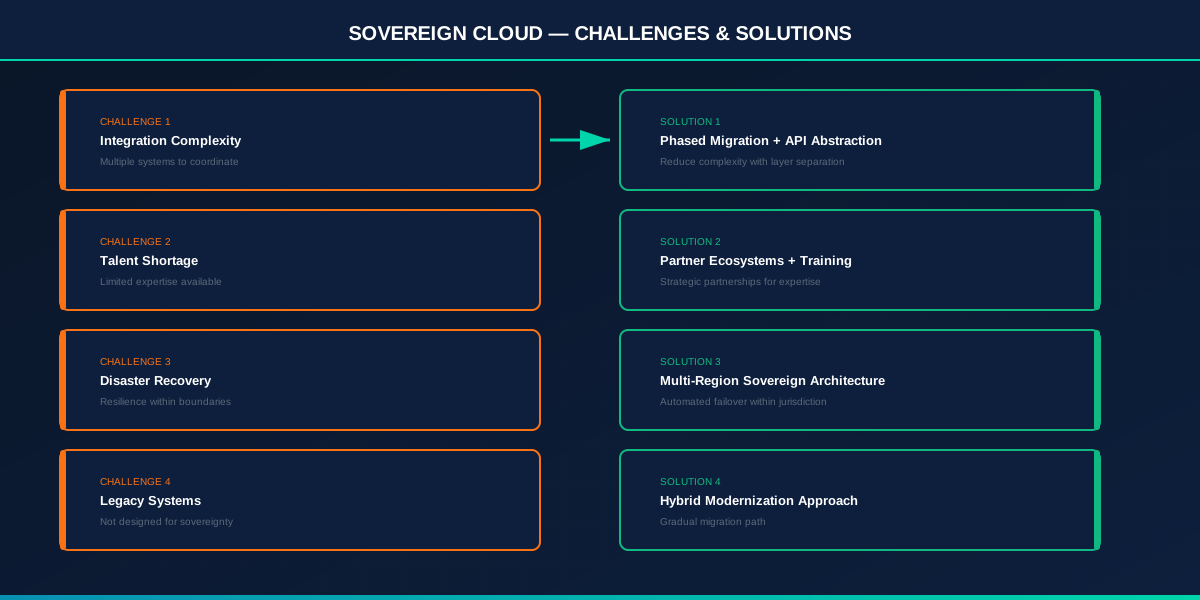
This multi-panel infographic presents four major implementation challenges organizations face when adopting sovereign cloud, paired with practical, proven solutions. The left-right arrow structure emphasizes that while challenges are real and significant, each has actionable mitigation strategies that successful organizations have deployed.
Key Points:
- Challenge 1: Integration Complexity (warning icon) - Existing applications tightly coupled to specific cloud provider services, APIs, and features; re-architecting for sovereignty requires significant engineering effort → Solution: Phased migration approach starting with greenfield applications, API abstraction layer to decouple applications from provider-specific services, use of cloud-agnostic technologies like Kubernetes for new deployments (positive icon with migration path)
- Challenge 2: Talent Shortage (warning icon) - Limited availability of engineers with both sovereign cloud architecture expertise and EU regulatory knowledge; competition for specialized talent → Solution: Partner ecosystems leveraging system integrators and managed service providers with sovereignty expertise, structured training programs upskilling existing teams on sovereign architecture patterns, use of certified consultants for design and implementation phases (positive icon with people/growth symbols)
- Challenge 3: Disaster Recovery (warning icon) - Sovereign cloud often has fewer regional options than global public cloud, creating DR planning complexity; concerns about data locality requirements conflicting with DR needs → Solution: Multi-region sovereign architecture using multiple EU/national sovereign regions for redundancy, active-active deployment patterns where regulations permit, DR-specific regulatory guidance ensuring backup/DR doesn't violate sovereignty (positive icon with resilience/redundancy symbols)
- Challenge 4: Legacy Systems (warning icon) - Decades-old applications built for on-premises infrastructure, not cloud-ready, incompatible with modern cloud architectures; complete re-write economically infeasible → Solution: Hybrid approach keeping legacy systems on-premises or in dedicated infrastructure while moving new workloads to sovereign cloud, gradual modernization through strangler fig pattern replacing functionality incrementally, containerization of legacy applications where possible for partial cloud migration (positive icon with bridge/transition symbols)
- Arrows connect each challenge to its corresponding solution, showing clear paths forward
- Color coding reinforces message: orange/warning colors for challenges, green/positive colors for solutions
Additional Context: These challenges represent the most common obstacles reported by enterprises in IDC and Gartner research on sovereign cloud adoption. Integration complexity is often underestimated—organizations discover they've inadvertently created deep dependencies on provider-specific services (AWS Lambda, Azure Cognitive Services, Google BigQuery) that have no direct sovereign equivalents, requiring substantial re-architecture. The talent shortage is particularly acute in sovereign cloud because it requires combined expertise in cloud architecture, EU regulatory frameworks, and security—a rare combination. Disaster recovery concerns are valid but often overblown; while sovereign cloud may offer fewer regions than AWS's 30+ global regions, most DR requirements are satisfied by 2-3 regional deployments, which sovereign providers increasingly offer. Legacy system challenges affect 80%+ of large European enterprises; the hybrid solution acknowledges that not everything needs to move to sovereign cloud immediately—prioritizing regulated data and customer-facing systems while legacy ERP and financial systems can remain on-premises temporarily. The phased, pragmatic approach reflected in these solutions contrasts with "all or nothing" thinking that paralyzes many organizations' sovereignty initiatives.
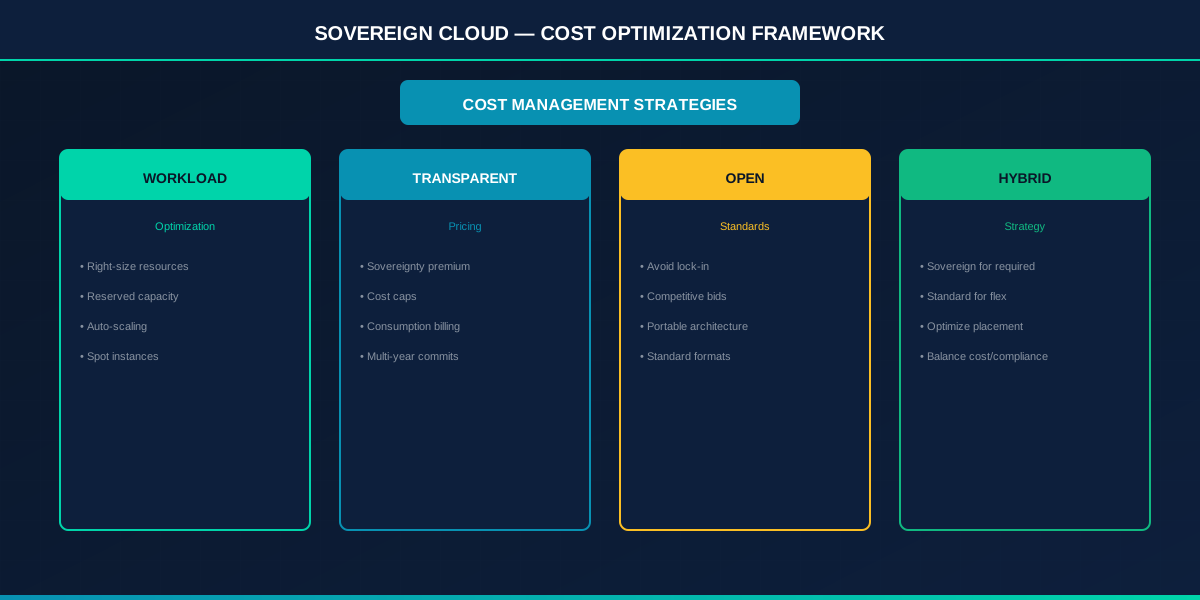
This four-pillar framework presents a comprehensive cost optimization strategy for sovereign cloud, addressing the reality that sovereign cloud typically costs 15-30% more than standard public cloud while providing actionable approaches to minimize total cost of ownership. The framework emphasizes that cost optimization is not about avoiding sovereignty but about maximizing value within sovereign constraints.
Key Points:
- Pillar 1: Workload Optimization - Right-size resources by matching instance types to actual workload requirements rather than over-provisioning (tools like CloudHealth, Densify); purchase reserved capacity for predictable workloads (20-40% savings vs on-demand); use spot/preemptible instances for fault-tolerant batch workloads; implement auto-scaling to match capacity to demand; shut down non-production environments during off-hours; optimize storage tiers moving infrequently accessed data to cold storage
- Pillar 2: Transparent Pricing - Understand the sovereignty premium (typically 15-30%) and what it covers (compliance architecture, dedicated resources, local operations); negotiate contractual cost caps or predictable pricing models rather than pure consumption-based which can surprise; implement chargeback/showback to create cost accountability across business units; use FinOps practices with regular cost reviews and optimization cycles; benchmark sovereign cloud costs against compliance alternatives (on-premises sovereign infrastructure often costs more)
- Pillar 3: Open Standards - Avoid vendor lock-in by using portable technologies (Kubernetes not proprietary container services, PostgreSQL not Aurora, Terraform not CloudFormation); enable competition by maintaining multi-provider capability, allowing re-negotiation from position of strength; build portable architecture using cloud-agnostic patterns and abstractions; maintain exit strategy with documented migration paths to alternative providers
- Pillar 4: Hybrid Strategy - Run sovereignty-required workloads (regulated data, critical systems) in sovereign cloud; use standard public cloud for non-sensitive workloads (development/test, marketing websites, analytics on anonymized data); keep legacy systems on-premises where cloud migration ROI is negative; implement intelligent workload placement decision framework based on regulatory requirements, not blanket policies
- Visual elements include cost icons (dollar signs), optimization symbols (downward arrows showing cost reduction), efficiency indicators (gears, gauges), and ROI metrics demonstrating value
- Clear visual hierarchy flows from strategic framework (top) through tactical pillars to specific actionable practices (bottom)
Additional Context: Cost concerns represent the most frequently cited barrier to sovereign cloud adoption in enterprise surveys, yet organizations often compare costs incorrectly. The proper comparison is not "sovereign cloud vs. public cloud" but rather "sovereign cloud vs. alternatives that achieve equivalent compliance and sovereignty guarantees"—when compared to building dedicated on-premises infrastructure with comparable certifications, sovereign cloud is typically more cost-effective. The 15-30% premium for sovereignty reflects real costs: dedicated infrastructure without multi-tenant economics, more extensive compliance certifications, local operational staff, and enhanced security controls. Organizations that successfully manage sovereign cloud costs report several patterns: they avoid treating all workloads identically (the hybrid strategy pillar), they implement FinOps rigor from day one rather than optimizing later, and they use sovereignty requirements as an opportunity to eliminate waste (workload optimization forces discipline often lacking in unlimited public cloud environments). The open standards pillar is strategic cost management—by maintaining portability, organizations retain negotiating power and avoid the price increases that typically follow lock-in. Cost optimization in sovereign cloud is fundamentally about informed decision-making: understanding what sovereignty costs, why it costs that amount, and how to achieve it efficiently while maintaining compliance guarantees.
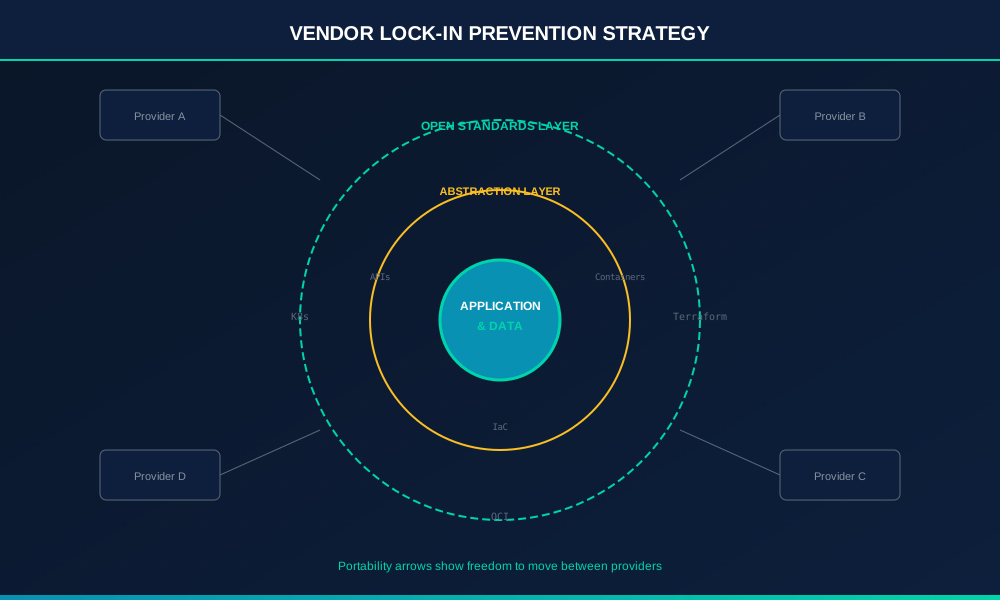
This concentric circles diagram illustrates a layered approach to preventing vendor lock-in in sovereign cloud environments. The center-to-outside flow shows how applications and data are progressively protected from provider dependencies through abstraction layers, open standards, and architectural patterns that enable true multi-cloud portability.
Key Points:
- Center Circle - Application/Data Core: Business applications, databases, and critical data assets that represent organizational investment; these must remain portable and independent of infrastructure choices; shown with unlocked padlock symbol indicating freedom from constraints
- Inner Ring - Abstraction Layer: Technical mechanisms that decouple applications from provider-specific infrastructure: API abstractions (service mesh, API gateways providing provider-agnostic interfaces), container orchestration (Kubernetes abstracting underlying compute), infrastructure as code using provider-agnostic tools (Terraform, Pulumi, Crossplane rather than CloudFormation or ARM templates), data abstraction layers (connection pooling, ORM frameworks reducing database coupling)
- Outer Ring - Multiple Cloud Providers: Diverse provider ecosystem including sovereign cloud providers, public cloud providers, and on-premises infrastructure; portability arrows show bidirectional movement capability between any providers; this ring represents the actual infrastructure options available once abstraction is implemented
- Outermost Ring - Open Standards Framework: Standards and technologies enabling portability: Kubernetes (CNCF standard for container orchestration), Terraform (de facto standard for IaC across providers), open data formats (Parquet, Avro, JSON not proprietary formats), standard APIs (REST, GraphQL, gRPC not vendor-specific), open-source databases (PostgreSQL, MySQL, MongoDB not Aurora, CosmosDB, DynamoDB), standard authentication (OIDC, SAML not provider-specific IAM)
- Portability arrows radiate from center outward and flow between provider segments, demonstrating that applications can move freely between any infrastructure options
- Unlocked padlock icons at multiple layers reinforce the "freedom from lock-in" message
- Color progression from warm (center, application core) to cool (outer rings, infrastructure) emphasizes the protection layers
Additional Context: Vendor lock-in prevention is particularly critical in sovereign cloud context because the regulatory landscape is evolving rapidly—organizations need the ability to change providers if regulatory interpretations change or if better sovereign offerings emerge. Lock-in occurs through three mechanisms: technical dependencies (using provider-specific services with no equivalents), data gravity (massive datasets expensive to move), and skill dependencies (teams trained only on one provider's tools). This framework addresses all three. The abstraction layer is technical lock-in prevention—by using Kubernetes instead of proprietary container services, organizations can move workloads between any Kubernetes-compatible provider. Open data formats and export APIs address data gravity by ensuring data can be efficiently extracted and transferred. The multi-provider capability addresses skill dependencies by forcing architectural patterns that work across providers. The framework is inspired by Cloud Native Computing Foundation (CNCF) principles and practices from organizations that have successfully maintained multi-cloud capability. Implementation requires discipline: teams must resist the convenience of provider-specific services even when they offer better features or lower costs in the short term. Organizations should establish architectural guardrails (approved services lists, architecture review boards) that enforce abstraction patterns. The Data Act's mandated switching capabilities (30-day provider switching requirement) will increasingly force providers to support these patterns, but organizations should implement them proactively rather than waiting for regulatory enforcement. Lock-in prevention is insurance—you may never need to switch providers, but having the capability provides negotiating power, reduces risk, and ensures strategic flexibility.
Implementation Roadmap
Assessment, planning, and execution framework
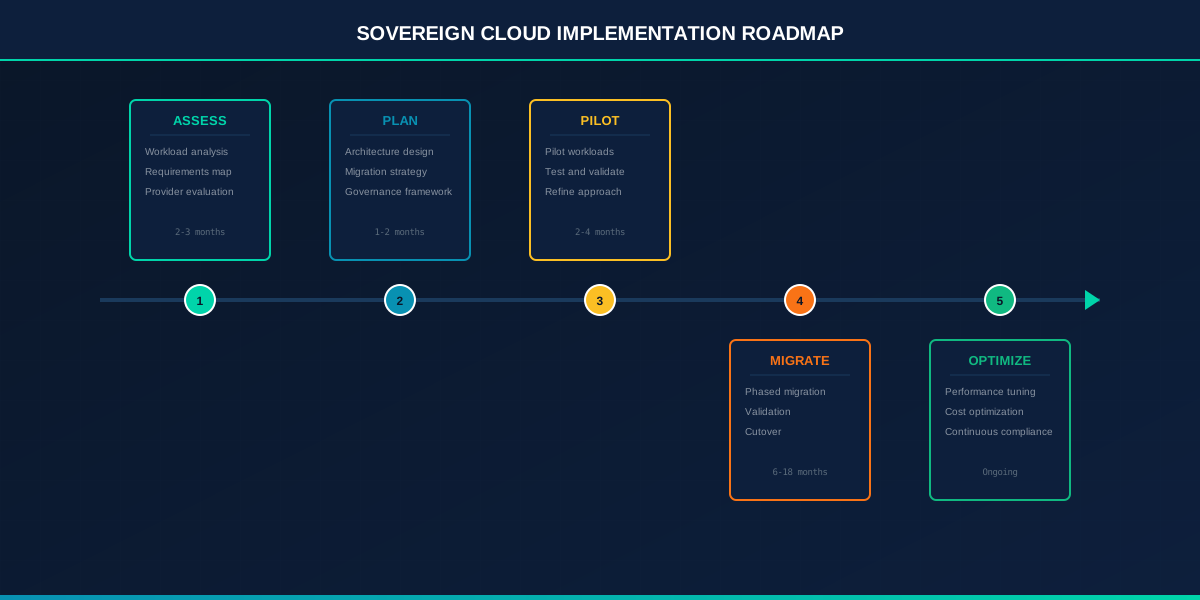
This comprehensive horizontal timeline roadmap presents the five-phase journey for sovereign cloud implementation, from initial assessment through ongoing optimization. The milestone-based structure with realistic duration estimates helps organizations plan and resource their sovereignty initiatives, emphasizing that implementation is a multi-year transformation rather than a one-time project.
Key Points:
- Phase 1: ASSESS (magnifying glass, checklist icons) - Duration: 2-3 months - Comprehensive workload analysis cataloging all applications, data stores, and their sensitivity classifications; requirements mapping identifying which regulations apply to which workloads; provider evaluation comparing sovereign cloud offerings against requirements; current state architecture documentation; risk assessment identifying compliance gaps and sovereignty requirements; stakeholder alignment ensuring executive sponsorship and cross-functional buy-in; deliverables include workload inventory, requirements matrix, provider shortlist, and business case
- Phase 2: PLAN (blueprint, strategy icons) - Duration: 1-2 months - Target architecture design defining sovereign cloud architecture, hybrid integration patterns, and security controls; detailed migration strategy with workload prioritization and sequencing; governance framework establishing policies, procedures, and decision rights; cost modeling and budgeting for realistic investment planning; risk mitigation planning for identified gaps; team structure and roles definition; deliverables include architecture blueprints, migration plan, governance documentation, and project charter
- Phase 3: PILOT (test tube, experiment icons) - Duration: 2-4 months - Select pilot workloads (typically 2-3 non-critical applications) to validate approach; build sovereign cloud foundation (networking, identity, security baseline); migrate pilot applications and test functionality; validate compliance controls and audit capabilities; document lessons learned and refine approach; train initial operations team; prove integration patterns with existing infrastructure; deliverables include working pilot environment, validated patterns, and refined implementation plan
- Phase 4: MIGRATE (arrow, movement icons) - Duration: 6-18 months - Phased migration of applications by wave (typically 4-8 waves), prioritizing by business value and compliance urgency; continuous validation testing after each migration wave; cutover coordination minimizing business disruption; parallel run periods where appropriate; decommission legacy infrastructure after successful migration; scale operations team as environment grows; deliverables include fully migrated workloads, validated compliance, and operational run books
- Phase 5: OPTIMIZE (gears, continuous improvement icons) - Duration: Ongoing - Performance tuning based on operational metrics; cost optimization implementing FinOps practices; continuous compliance monitoring adapting to regulatory changes; architecture evolution incorporating new services and capabilities; operational excellence through automation and process improvement; security posture enhancement responding to threat landscape; knowledge transfer and team capability building; this phase never truly ends as environment and requirements evolve
- Timeline visualization uses gradient or color progression showing advancement from assessment (cooler colors) to optimization (warmer colors)
- Milestones marked at phase transitions showing decision gates and key deliverables
Additional Context: These durations represent typical enterprise implementations based on industry research and practitioner experience. Small to medium organizations might compress timelines by 30-40%, while very large enterprises or those with complex regulatory requirements might extend them. The Assessment phase often reveals surprises—organizations discover they don't know where all their data resides or which regulations apply to which systems, extending this phase. The Planning phase is critical and should not be rushed; inadequate planning is the leading cause of implementation failures. The Pilot phase validates assumptions before committing to full migration—organizations that skip piloting often encounter unexpected issues during production migration. Migration duration varies dramatically based on portfolio size (10 applications vs. 1000 applications), architectural complexity (monolithic legacy apps vs. modern microservices), and risk tolerance (aggressive vs. cautious migration approach). The Optimize phase emphasizes that sovereign cloud is not "set and forget"—regulations evolve, technology advances, and organizational needs change, requiring continuous adaptation. Organizations should expect to invest 12-24 months from Assessment kickoff to Migration completion for moderately complex environments, with ongoing Optimization investment of 5-10% of infrastructure spend annually. Success factors include strong executive sponsorship, dedicated program management, cross-functional team involvement (IT, security, compliance, legal, business), adequate budget with contingency, and realistic expectations about timeline and effort required.
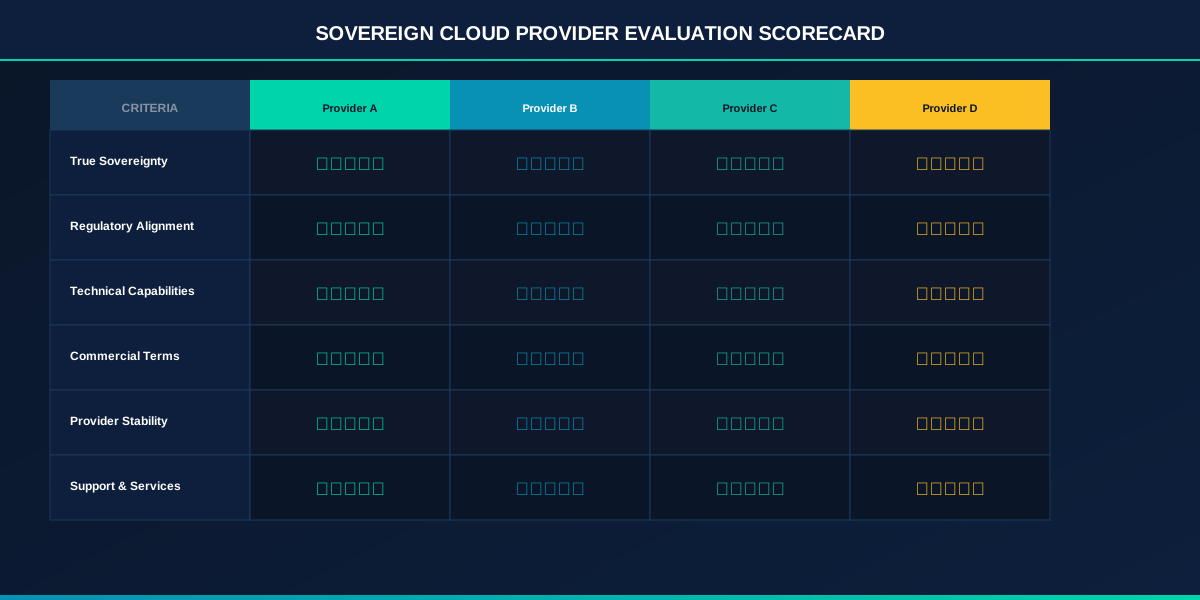
This professional evaluation scorecard provides a structured framework for comparing sovereign cloud providers across six critical dimensions. The matrix format with space for 3-4 providers enables objective, criteria-based assessment rather than subjective provider preference, supporting defensible procurement decisions and stakeholder alignment.
Key Points:
- Row 1: True Sovereignty (Weight: High) - Assesses actual sovereignty guarantees beyond marketing claims: legal independence from non-EU jurisdiction (is provider legally subject to CLOUD Act or similar?), operational control location (where are operations teams based and who employs them?), data access controls (can provider access customer data? are keys customer-controlled?), management plane sovereignty (where do control planes operate?), physical infrastructure location (data center locations and ownership), contractual sovereignty guarantees (what's legally binding vs. best-effort?); rating 1-5 stars from "contractual assurances only" to "architecturally guaranteed sovereignty"
- Row 2: Regulatory Alignment (Weight: High) - Evaluates compliance with specific regulations relevant to your industry: GDPR compliance and certifications, NIS2 readiness and controls, DORA capabilities (for financial services), industry-specific certifications (ISO 27001, SOC 2, C5, SecNumCloud, etc.), audit readiness and reporting tools, regulatory change responsiveness; rating based on breadth and depth of compliance capabilities
- Row 3: Technical Capabilities (Weight: Medium-High) - Assesses technical service breadth and maturity: compute options (VM types, container services, serverless), storage services (block, object, file storage), networking capabilities (VPN, direct connect, load balancing), database options (managed databases, data warehousing), security services (WAF, DDoS protection, SIEM), DevOps tooling (CI/CD, monitoring, logging), AI/ML capabilities (particularly sovereign AI readiness); rating based on service completeness and maturity
- Row 4: Commercial Terms (Weight: Medium) - Evaluates pricing and contractual terms: pricing transparency and competitiveness, contract flexibility (terms, exit clauses), pricing model options (consumption, reserved, committed use), cost predictability and capping, volume discounts and incentives, Data Act compliance (switching support, portability); rating based on commercial attractiveness and flexibility
- Row 5: Provider Stability (Weight: Medium) - Assesses long-term viability and reliability: financial stability and backing, market position and customer base, technology roadmap and investment, geographic footprint and expansion plans, SLA commitments and track record, business continuity and resilience; rating based on confidence in long-term provider viability
- Row 6: Support & Services (Weight: Medium) - Evaluates support quality and partner ecosystem: technical support availability and quality, migration assistance and tools, professional services capabilities, partner ecosystem and integrators, training and certification programs, documentation and community; rating based on support comprehensiveness
- Bottom Row: Total Weighted Score - Calculated total considering criterion weights; highest score indicates best fit but should trigger qualitative discussion not automatic selection
- Color-coded rating scale flows red (1 star, inadequate) through yellow (3 stars, adequate) to green (5 stars, excellent)
- Space for 3-4 provider names in columns allows direct comparison
Additional Context: This scorecard operationalizes provider evaluation, which is often too subjective or driven by brand recognition rather than actual capability. The "True Sovereignty" criterion is deliberately first and weighted highest because it's the defining requirement—technical capabilities or cost advantages are irrelevant if sovereignty guarantees are inadequate. Organizations should customize criterion weights based on their priorities: highly regulated financial institutions might weight Regulatory Alignment even higher, while technically sophisticated organizations might weight Technical Capabilities higher. The scorecard should be completed collaboratively with cross-functional teams (procurement, IT, security, compliance, legal) as different stakeholders have visibility into different criteria. Common evaluation pitfalls include: accepting marketing claims about sovereignty without architectural validation, underweighting Provider Stability leading to selection of providers who later exit the market, focusing solely on current capabilities without assessing roadmap and commitment to sovereign cloud evolution, and failing to test claims through proof-of-concept before scoring. The scorecard is not meant to mechanically select the highest-scoring provider but rather to structure discussion and ensure all critical factors are considered. In practice, the top 2-3 scoring providers should proceed to detailed proof-of-concept validation before final selection. Organizations should also consider "table stakes" criteria—minimum acceptable scores in True Sovereignty and Regulatory Alignment below which a provider is automatically disqualified regardless of strengths in other areas.
Conclusion & Appendices
Future vision, regulatory reference, and provider comparison
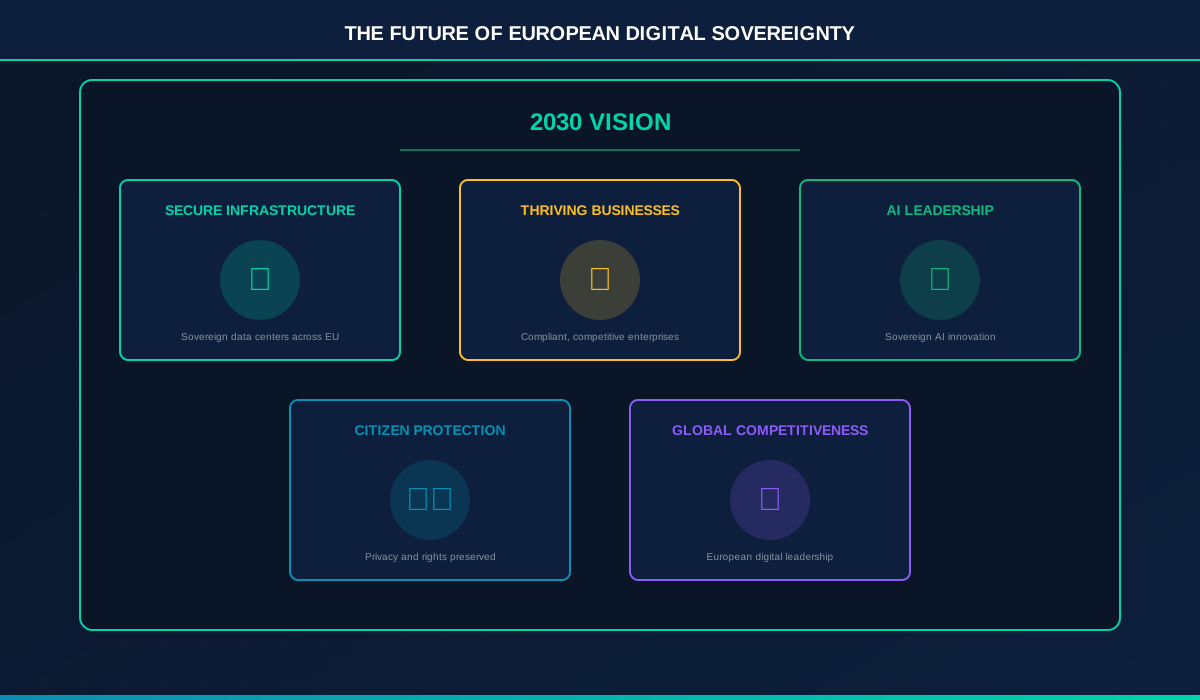
This forward-looking illustration presents an optimistic vision of Europe's digital sovereign future, with three visual layers depicting secure infrastructure, thriving digital economy, and collaborative innovation. The progression from foreground to background represents the journey from foundational sovereignty to realized digital autonomy and competitiveness.
Key Points:
- Foreground - Secure Sovereign Infrastructure: Stylized data centers rendered in EU flag colors (blue and gold) representing sovereign cloud infrastructure across Europe; visual elements include shield icons emphasizing security and jurisdictional protection, lock symbols indicating customer-controlled encryption, and geographic markers showing multi-regional European coverage; infrastructure depicted as modern, efficient, and technologically advanced—dispelling misconceptions that sovereignty means outdated technology
- Middle Ground - Thriving Digital Economy: Diverse businesses and organizations successfully operating on sovereign infrastructure: people collaborating across organizations with secure data flows, applications and AI systems processing data with compliance guarantees, digital services delivered to citizens and customers, innovation occurring without compromise to sovereignty; visual representation shows growth arrows indicating economic expansion, checkmark symbols confirming compliance, and flowing connections representing secure inter-organizational data sharing enabled by common sovereignty framework
- Background - European Digital Landscape: Panoramic view of integrated European digital ecosystem: innovation clusters across member states, cross-border collaboration and data sharing, research and AI development within sovereign boundaries, competitive global position in digital services, educational institutions training sovereignty-skilled workforce; background conveys sense of digital autonomy, technological leadership, and strategic independence
- Supporting Visual Elements: Shield icons throughout representing security through sovereignty, checkmarks symbolizing continuous compliance, upward growth arrows indicating economic opportunity, connected nodes showing collaboration enabled by sovereignty framework, gradient color progression from current-state blue to future-state gold suggesting positive transformation
- Overall composition is modern, optimistic, and professional—aspirational but achievable future, not science fiction
Additional Context: This vision represents the strategic ambition behind European digital sovereignty initiatives—not defensive protectionism but affirmative digital autonomy. The European Commission's Digital Decade 2030 targets explicitly link digital sovereignty to competitiveness: 75% of EU enterprises using cloud/AI/Big Data by 2030, 20 million ICT specialists in Europe, doubling of unicorn startups. Sovereign cloud infrastructure is foundational to these ambitions—organizations cannot innovate with AI if training data must be exported outside EU jurisdiction, cannot digitally transform if infrastructure depends on foreign legal frameworks, cannot compete globally if competitive intelligence risks foreign surveillance. The vision acknowledges that sovereignty is not isolation but rather secure participation in global digital economy on European terms. The connected nodes symbolize an important benefit: common European sovereignty framework enables easier cross-border collaboration among EU organizations than current fragmented approach where each organization negotiates sovereignty individually. The AI systems in middle ground represent sovereign AI—the next frontier where Europe aims for leadership, with regulations like AI Act creating framework for trustworthy AI development that could become global standard (similar to how GDPR influenced global privacy regulations). The optimistic tone is deliberate counterpoint to sovereignty discourse that often emphasizes threats and risks; this vision emphasizes opportunity, innovation, and competitive advantage. The gradient from blue (current) to gold (future) suggests transformation is both necessary and achievable with deliberate action starting in 2026. This is not distant future but achievable state within 5-7 years if organizations, providers, and policymakers execute on emerging sovereign cloud frameworks.
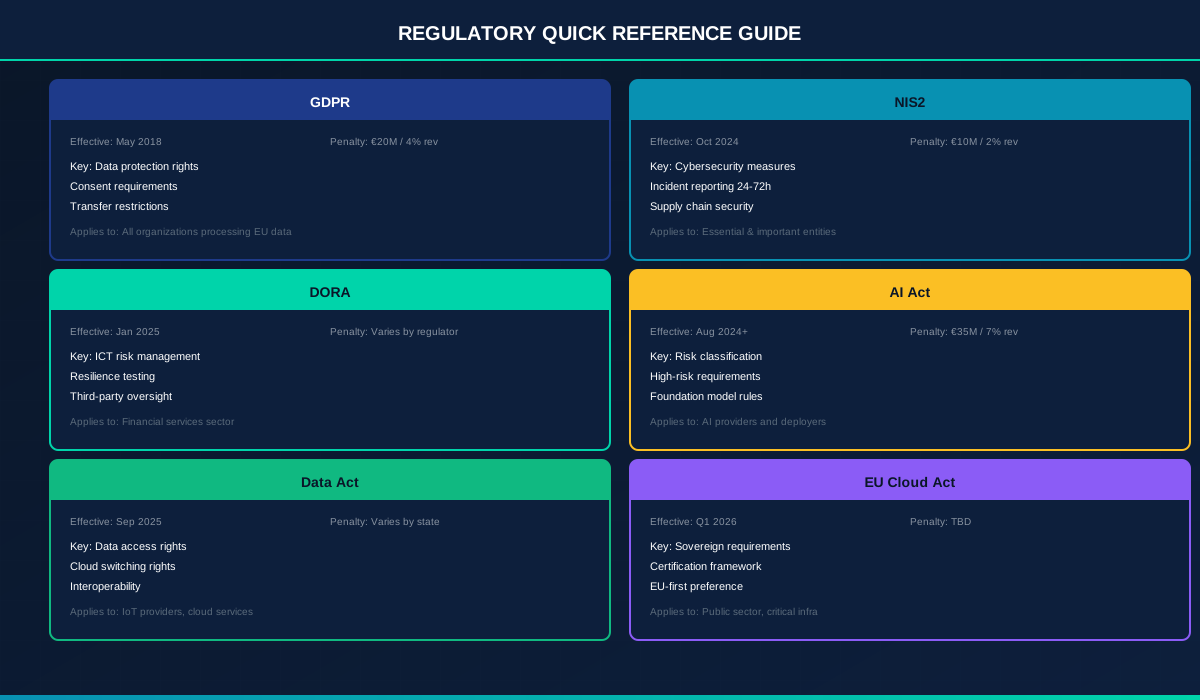
This comprehensive regulatory quick reference infographic presents six major EU regulations driving sovereign cloud adoption, organized chronologically with key details for each. The table/timeline hybrid structure enables quick lookup of applicability, requirements, penalties, and effective dates—serving as a practical reference tool for compliance teams.
Key Points:
- GDPR (General Data Protection Regulation) - Effective: May 25, 2018 - Icon: shield with checkmark (data protection); Key Requirements: lawful basis for processing, data subject rights (access, erasure, portability), data protection by design and default, privacy impact assessments for high-risk processing; Penalties: up to €20 million or 4% of global annual revenue, whichever is higher; Applies To: all organizations processing EU residents' personal data regardless of location
- NIS2 (Network and Information Security Directive 2) - Effective: January 16, 2023 (member state implementation by October 2024) - Icon: network with shield (cybersecurity); Key Requirements: risk management measures, incident reporting (24 hours for early warning, 72 hours for detailed report), supply chain security, cybersecurity governance at management level; Penalties: up to €10 million or 2% of global annual revenue for essential entities; Applies To: essential and important entities across 18 sectors including energy, transport, healthcare, digital infrastructure, public administration
- DORA (Digital Operational Resilience Act) - Effective: January 17, 2025 - Icon: building blocks with resilience symbol (operational resilience); Key Requirements: ICT risk management framework, incident classification and reporting, digital operational resilience testing, third-party ICT service provider risk management; Penalties: varies by entity type, up to 2% of annual worldwide turnover; Applies To: financial entities including banks, insurance companies, investment firms, payment institutions, crypto-asset service providers
- Data Act - Effective: September 2023 (application from September 2025) - Icon: data transfer arrows (data access and portability); Key Requirements: data access rights for users and third parties, cloud switching provisions (max 30 days for non-complex scenarios), interoperability requirements, restrictions on international data access; Penalties: up to €20 million or 4% of global annual revenue; Applies To: data holders, cloud service providers, data processing service providers
- AI Act - Effective: August 2024 (phased implementation through 2027) - Icon: AI brain with governance framework (AI regulation); Key Requirements: risk-based approach with prohibited practices, high-risk AI system requirements (risk management, data governance, transparency, human oversight), transparency obligations for AI systems, conformity assessments; Penalties: up to €35 million or 7% of global annual revenue for prohibited practices; Applies To: providers and deployers of AI systems in EU market
- EU Cloud & AI Development Act - Expected: Q1 2026 (proposed) - Icon: cloud with EU flag (cloud sovereignty); Key Requirements: sovereign cloud requirements for critical data, EU-based operational control mandates, technology independence provisions, sovereignty-by-design principles; Penalties: to be determined in final legislation; Applies To: cloud service providers serving EU public sector and critical infrastructure sectors (expected)
- Timeline visualization runs vertically or horizontally showing chronological progression and convergence toward 2026
- Color coding by regulation type: blue for data protection (GDPR, Data Act), red for cybersecurity (NIS2), orange for operational resilience (DORA), purple for AI governance (AI Act), gold for cloud sovereignty (Cloud & AI Development Act)
Additional Context: This quick reference addresses the common challenge of regulatory confusion—organizations struggle to understand which regulations apply to them and what compliance entails. The chronological presentation shows the regulatory evolution: GDPR established data protection foundation in 2018, NIS2 added cybersecurity mandates in 2023, DORA brought operational resilience requirements in 2025, and upcoming Cloud & AI Development Act will explicitly mandate sovereignty architecture in 2026. The penalty structures reveal regulatory priorities: AI Act has highest penalties (up to 7% of revenue for prohibited practices) reflecting serious concern about AI risks, while GDPR and Data Act share the 4% maximum emphasizing data rights. Organizations should note that penalties are cumulative—violating multiple regulations simultaneously can result in stacked penalties. The "Applies To" field is critical for scoping compliance efforts: GDPR applies universally to anyone processing EU personal data, while DORA applies only to financial sector, NIS2 to designated sectors, and AI Act to AI system providers/deployers. Organizations should map their operations against these applicability criteria to determine their specific compliance obligations. The phased implementation timelines are important for planning: while AI Act is "effective" in 2024, most requirements don't apply until 2025-2027, providing implementation time. The Cloud & AI Development Act remains proposed legislation as of early 2026, but organizations should monitor its progress as it will likely mandate specific sovereign cloud architectures. This reference should be updated quarterly as regulations evolve and implementation guidance emerges from regulatory authorities like EDPB, ENISA, and national data protection authorities.
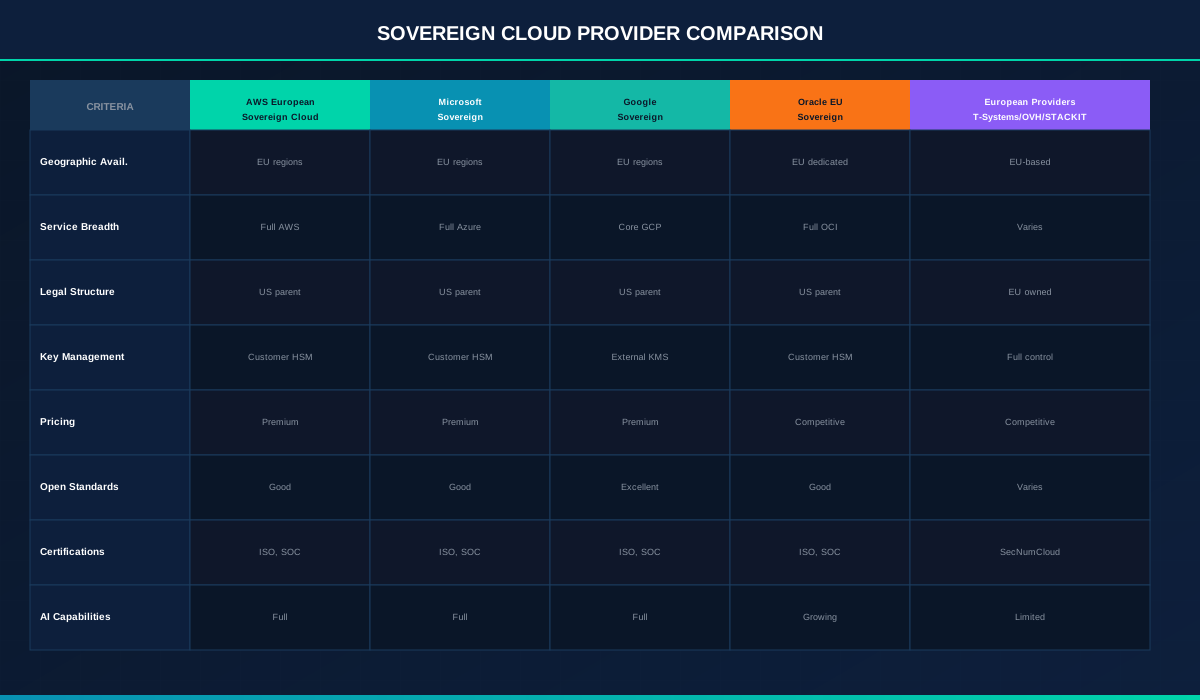
This comprehensive provider comparison table maps five major sovereign cloud provider categories across nine critical evaluation dimensions. The side-by-side format enables direct comparison of offerings, helping organizations understand trade-offs between hyperscaler-based solutions and pure European providers.
Key Points:
- Row 1: Geographic Availability - AWS European Sovereign Cloud: Germany (planned expansion); Microsoft Sovereign Solutions: Germany, France (via partners); Google Sovereign Cloud: Limited availability, partner-dependent; Oracle EU Sovereign Cloud: Germany, France, Netherlands; European Providers: Extensive EU coverage (OVHcloud: 15+ EU locations, T-Systems/STACKIT: Germany, broader EU)
- Row 2: Service Breadth - AWS: Broad services (subset of global AWS); Microsoft: Comprehensive Azure stack; Google: Limited sovereign services; Oracle: Strong database/enterprise, growing cloud services; European Providers: Variable (T-Systems extensive via cloud partnership, OVHcloud strong compute/storage, STACKIT growing portfolio)
- Row 3: Legal Structure - AWS: AWS-owned, dedicated sovereign regions; Microsoft: Partner-operated model (T-Systems, others); Google: Unclear/developing partner models; Oracle: Oracle EU entity with separation guarantees; European Providers: Fully EU-owned and operated, no foreign parent company jurisdiction
- Row 4: Operational Control - AWS: AWS-controlled with customer safeguards; Microsoft: Partner-controlled operations, Microsoft technology; Google: Unclear operational model; Oracle: Oracle EU operations with contractual separation; European Providers: Customer-controlled, EU-based operations teams
- Row 5: Key Management - AWS: Customer-controlled keys (BYOK), sovereign KMS; Microsoft: Customer-managed keys, Azure Key Vault sovereignty; Google: Standard BYOK where available; Oracle: Customer-controlled encryption, sovereign key management; European Providers: Typically customer-controlled, some offer sovereign HSM options
- Row 6: Pricing Model - AWS: Premium pricing (20-30% over standard); Microsoft: Premium pricing, partner markup possible; Google: Not publicly disclosed; Oracle: Competitive with standard Oracle cloud; European Providers: Generally competitive, variable by provider (OVHcloud cost-competitive, T-Systems premium for enterprise)
- Row 7: Open Standards Support - AWS: Moderate (proprietary services exist); Microsoft: Moderate (Azure-specific services); Google: Moderate (GCP-specific services); Oracle: Strong (emphasis on standards, portability); European Providers: Generally strong (open-source focus, portability emphasis)
- Row 8: Certifications - All providers: ISO 27001, SOC 2; AWS/Microsoft/Oracle: C5, various national certifications; European Providers: Extensive EU certifications (SecNumCloud for French providers, BSI C5, national certifications)
- Row 9: AI Capabilities - AWS: Strong AI/ML services (SageMaker, Bedrock subset); Microsoft: Comprehensive AI (Azure OpenAI, Cognitive Services); Google: Limited in sovereign context; Oracle: Developing AI capabilities; European Providers: Variable (growing partnerships with EU AI providers, some native capabilities)
- Visual treatment uses checkmarks (✓) for strong capabilities, tilde (~) for partial/moderate capabilities, X for weak/unavailable, and color coding (green for strong, yellow for moderate, red for weak) for quick scanning
Additional Context: This comparison reveals fundamental trade-offs in sovereign cloud provider selection. Hyperscaler-based offerings (AWS, Microsoft, Oracle) generally provide broader service portfolios and more mature AI capabilities but face questions about legal jurisdiction and operational sovereignty—particularly whether partner-operated models (Microsoft's approach) or contractual separations (Oracle's approach) provide sufficient sovereignty guarantees to satisfy regulators. Pure European providers (T-Systems Sovereign Cloud, OVHcloud, STACKIT, plus others like Ionos, Scaleway) offer clearer sovereignty by eliminating US jurisdiction entirely but typically have narrower service portfolios and less mature AI offerings. Geographic availability patterns reflect provider strategies: hyperscalers focus on 1-2 initial sovereign regions, while European providers often have broader EU coverage due to their regional heritage. Legal structure is arguably the most critical row—organizations must decide whether partner-operated models resolve CLOUD Act conflicts or whether only fully EU-owned providers provide adequate sovereignty. The European Data Protection Board and national regulators continue debating this question. Operational control differences are subtle but important: who can access systems, who responds to incidents, who makes architecture decisions—these operational realities may matter more than legal structures in practice. Pricing reflects the "sovereignty premium"—all sovereign offerings cost more than standard public cloud, typically 15-30%, but with variation: European providers sometimes compete on price as strategic differentiator, while hyperscalers price sovereignty as premium tier. Open standards support correlates with lock-in risk: providers emphasizing proprietary services (AWS Lambda, Azure Cosmos DB) create migration friction, while those emphasizing open standards (Kubernetes, PostgreSQL) maintain portability. Organizations should weight these factors according to their priorities: highly regulated organizations may require pure European providers regardless of service limitations, while others may accept hyperscaler solutions if they resolve immediate sovereignty requirements while maintaining broader service access. The comparison should be periodically updated as sovereign cloud market evolves rapidly with new offerings, expanded geographies, and enhanced capabilities emerging quarterly.
This professional back cover design synthesizes the whitepaper's key messages into a memorable, actionable summary while providing contact information and resource access. The layout balances visual appeal with practical utility, serving both as design closure and as a quick reference for decision-makers who may start at the back of the document.
Key Points:
- Top Section - Branding: Company logo prominently displayed with positioning tagline emphasizing expertise in European digital sovereignty and secure cloud infrastructure; reinforces brand identity established on front cover
- Middle Section - Key Takeaways Box: Highlighted panel containing four essential messages that encapsulate the whitepaper's strategic insights:
- "Sovereignty is Architectural, Not Contractual" - True digital sovereignty requires architecture-level guarantees (dedicated infrastructure, jurisdictional control, operational independence) rather than contractual promises that may be overridden by foreign laws
- "2026 is the Pivotal Year for Sovereign Cloud" - Convergence of NIS2 amendments, DORA implementation, and emerging EU Cloud & AI Development Act creates regulatory inflection point when sovereignty shifts from optional to mandatory for regulated sectors
- "Hybrid Approaches Balance Compliance and Efficiency" - Organizations don't need all-or-nothing sovereignty; intelligent workload placement combining sovereign cloud for sensitive data with standard cloud for non-regulated workloads optimizes both compliance and cost
- "Open Standards Prevent Vendor Lock-In" - Architecture based on Kubernetes, Terraform, open data formats, and standard APIs ensures portability between providers, maintaining negotiating power and strategic flexibility as market evolves
- Bottom Section - Engagement Options: Multiple pathways for reader action: contact information (email, phone) for sales and consultation inquiries, website URL for additional resources and thought leadership, QR code enabling instant mobile access to whitepaper landing page with related content, social media handles for ongoing engagement
- Background Design: Subtle, non-distracting visual treatment featuring either abstract European map outline showing geographic scope of sovereignty concerns, or abstract cloud/data visualization with flowing nodes representing secure data flows; rendered in EU flag colors (blue and gold) maintaining visual consistency with front cover; background provides visual interest without competing with foreground content
- Design Consistency: Typography, color palette, and visual language consistent with front cover and interior pages, creating cohesive professional document; clean, uncluttered layout with clear hierarchy ensuring readability
Additional Context: The back cover serves multiple functions beyond aesthetic closure. The key takeaways box is strategically designed for executives who may flip to the back for a summary before deciding whether to read the full document—these four messages can stand alone as an elevator pitch for sovereign cloud. "Sovereignty is Architectural, Not Contractual" directly challenges the common misconception that data residency clauses in standard cloud contracts provide adequate sovereignty—this message positions true sovereign cloud as differentiated offering. "2026 is Pivotal Year" creates urgency driving near-term action rather than indefinite planning. "Hybrid Approaches Balance Compliance and Efficiency" reduces barrier to adoption by addressing cost concerns and acknowledging that full sovereignty migration isn't always necessary. "Open Standards Prevent Vendor Lock-In" addresses the second most common objection (after cost) by emphasizing that sovereignty doesn't mean permanent commitment to a single provider. The QR code reflects modern content consumption patterns—many readers will photograph or scan the back cover for later reference, and the QR code ensures they can easily access digital resources without manually typing URLs. The contact information placement acknowledges that the back cover may be the first thing prospects see when the document is lying on a desk, so it needs to facilitate immediate engagement. The subtle European map background reinforces the geographic and jurisdictional themes central to sovereignty without being overly nationalistic—this is about legal jurisdiction and regulatory compliance, not political statements. The EU flag color scheme (blue and gold) has become the de facto visual language of European digital sovereignty initiatives, making the document immediately recognizable as addressing this domain. Overall, the back cover design reflects best practices from B2B thought leadership content: clear takeaways for busy executives, multiple engagement pathways accommodating different preferences, visual consistency supporting brand recognition, and practical utility ensuring the document remains valuable reference even after initial read.